|
|
Submachine guns of
United Kingdom |
|
The BSA Thompson 1926, Thompson 1928A1, Lanchester, Sten
of WW2
|
|
and the Sterling
|
|
Text and pictures by
Olof Janson unless otherwise stated. |
 |
Special regards to the CG Factory Museum in Eskilstuna
and late Col. Carl Axel Ekfeldt
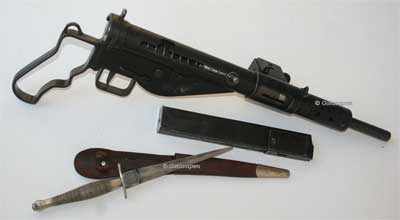
On the picture to the left:
Sten MkII with pistol grip
F-S 1st Pattern |
updated
2020-11-21
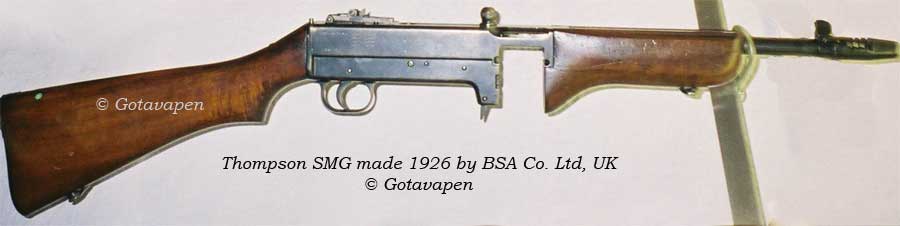
The BSA Thompson 1926.
|
When the 2nd World War started the
army of United Kingdom had a lack of all types of weapons. After the Great
War they dreamed about “No more wars”. They even put their rifles on the
streets and let their tanks run over them.
The senoir military, who always prefer to
prepare for the past war instead of the next, were quite satisfied with
their Lee Enfield rifles who were very fast to shoot with, although not as
fast as an automatic rifle or a submachine gun.
BSA Co Ltd. had developed a
modification of the Thompson Submachine gun in 1926 in calibre 9x20 mm, but
the British army did not show much interest in submachine guns until after
the war started. |
 |
|
The picture above from top to bottom:
Lanchester Mk1 Weight 4,6 kg,
9x19 mm, 575-600 r.p.m., 50 rd. boxmagazine
Bermann MP28 II, Weight 4 kg,
9x19 mm, 550-600 r.p.m., 32 rd. staggerd column
BSA 1926 Thompson, Weight 4
kg, 9x20 mm, 500 r.p.m., Thompson mags.
|
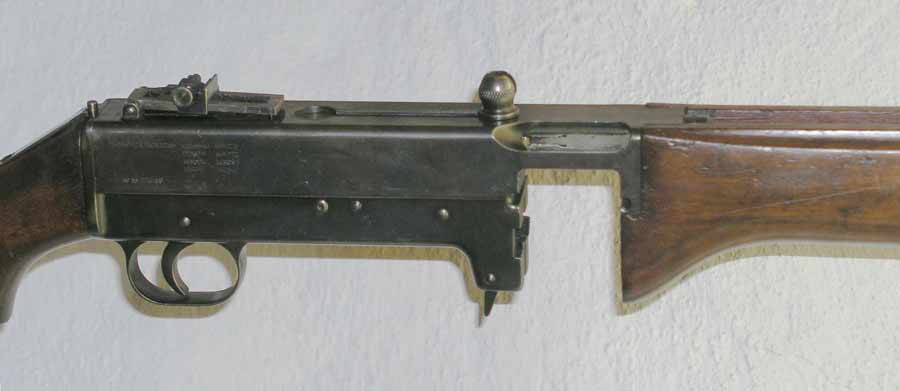 |
| Above details of a BSA Co.
Ltd 1926 by John T. Thompson. |
|
The
submachine guns of the Commando units.
Thompson 1928A1 |
|
 |
|
As stated before - When the 2nd World War started the
army of United Kingdom had a lack of all types of weapons.
On the 4th
of June 1940, Winston Churchill wrote to General Ismay in the War Cabinet
Secretariat concerning the need to start a new unit to combat the German
Blitz Krieg. The British formed special commando units to carry out raids.
On the 8th of June 1940, Section M09 of the War Office was
brought into being. These units were called Commandos.
The Commando units demanded a short effective weapon with high fire power. UK had no
submachine gun at all when the war started.
It became a desperate need for these submachine guns.
Great Britain
became the first country during the war to adopt the Thompson Submachine gun
(SMG) M1928A1, quickly followed by Sweden. As mentioned above the British
had already made tests with Thompson SMG:s. |
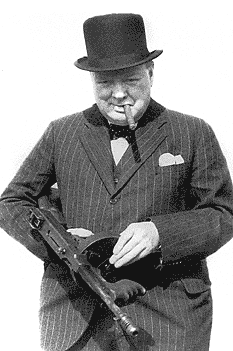 |
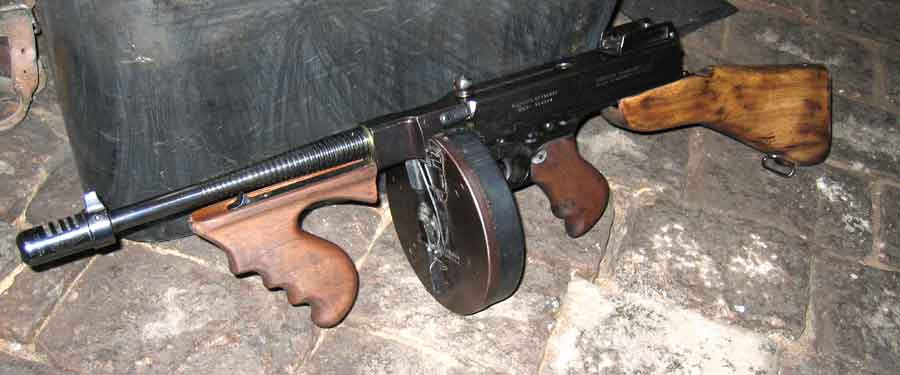
Thompson 1928A1
In 1940 UK bought large numbers of
the Thompson 1928A1 from Auto Ordnance Corp. in USA. It was the first
country to use the Thompson submachine gun in a war.
Thompson Submachine gun M1928A1 was used by the early
Commandos here with vertical front grip and later straight wooden forend.
Foto Imperial War Museum Nr H2646A |
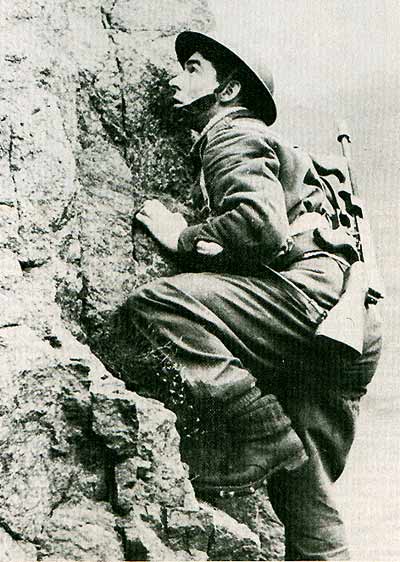 |
Thompson 1928A1
was the primary submachine gun for the newly formed Commando units which
were trained by the two famous captains W. E. Fairbairn and Eric Anthony
“Bill” Sykes. You can read more about them in the article about the Fairbairn Sykes Fighting knife. Bill Sykes was a very tough teacher with the
Tommy-gun for the young Commandoes.
Here is one of those Commandoes
during his training in climbing a rock.
|
|
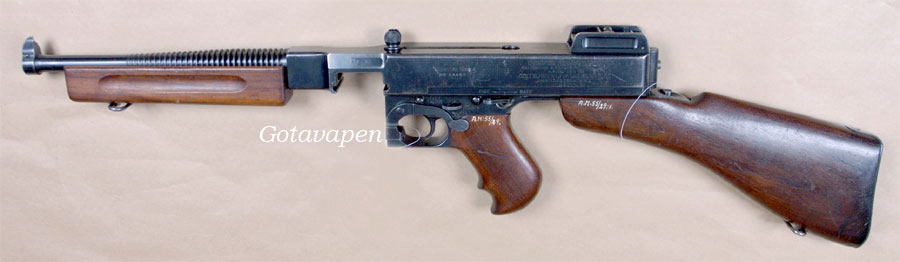
|
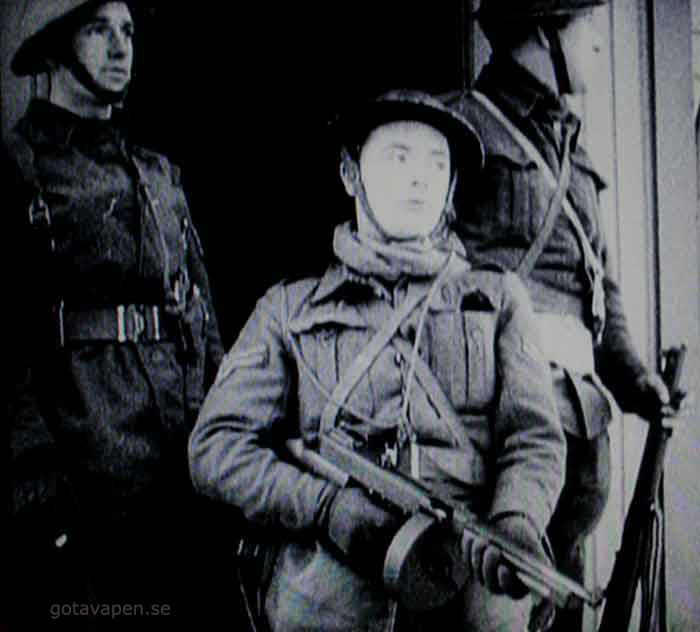 |
|
Here is a picture of
Cpt. John Shaw at British Commandos from Lofoten Islands. This was the
Claymore raid in
Norway on 4th of March 1941 |
|
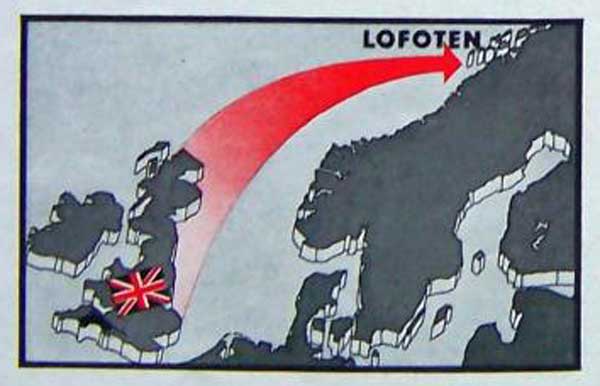
Operation
Claymore was a raid on the Lofoten Islands. It was carried out on the 4th of
March 1941 by British Commando and Royal Naval units on the remote islands
off the coast of Norway. The raid was
conducted by approximately 1000 men of No. 3 and No 4 Commando, 52
Norwegians of Norwegian Independent Company 1 and demolition teams from the
55th Field Squadron Royal Engineers.
The raid
was very successful. |
[Top of the
page]
|
|
|
 |
|
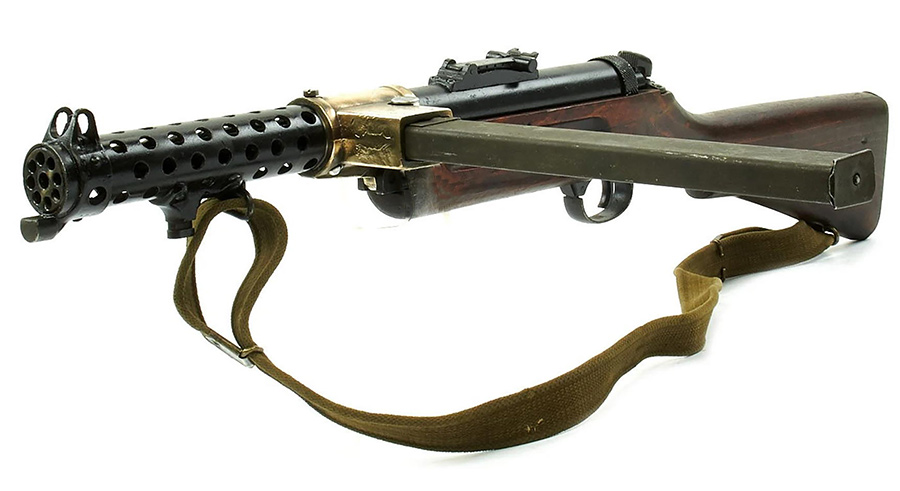
Lanchaster SMG MK1
|
 |
|
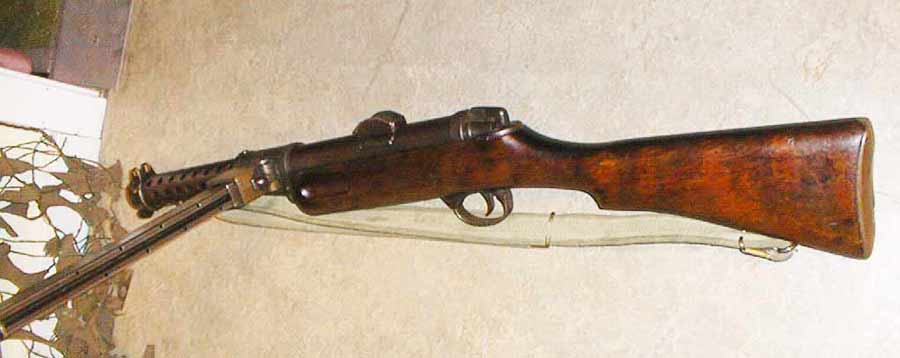
Lanchaster SMG MK1*.
This submachine gun was designed by G.H. Lanchester. It’s a copy of the
German Bergmann MP28 II. The Lanchester was
manufactured by the Sterling Armaments Company between 1941 and 1945.
Sterling Armaments Company was the same company, that later produced the
Sterling submachine gun
at the end of WW2.
Lanchester SMG was manufactured in two versions, MK1 and MK1* - the MK1*
was a simplified version of the original MK1. The later version had no
fire selector and simplified sights.
After Dunkirk in June 1940 Royal Air Force Regiment realized that they
needed a defense weapon for the protection of their airfields. In
shortage of time a copy of the Bergmann
MP28 II became the choice for RAF.
British Royal Navy joined them also. For this reason it was basically
used by the British Royal Navy during the Second World War, and to a
lesser degree by the RAF Regiment for airfield protection.
It was a very solid, well-made submachine gun of high-quality materials
and expensive to produce. Quite the contrary to the Sten!
The Lanchester MK1 had a heavy wooden stock, a machined-steel action and
breech block, a magazine housing made from solid brass! At the muzzle of
the SMG there was a bayonet mount for the very long British standard
bayonet M1907. As mentioned the MK1 had a selector for full auto or
single shots, which was
positioned differently compared to the Bergmann at the rear end of the
receiver.
Beside it is equipped with a bayonet. It is not very common that
submachine guns are equipped with bayonets but the British wanted this
equipment during the war.
The later model MK1* was full auto only.
It was a typical pre war submachine gun and expensive to produce.
It is a very heavy and clumsy submachine gun. However it is very easy to
handle during full automatic fire due to the heavy construction.
Lanchaster SMG MK1
Weight 4,6 kg,
Calibre 9x19 mm,
Cyclic rate: 575-600 r.p.m.,
Magazine 50 rd. box |
|
The Sten |
|
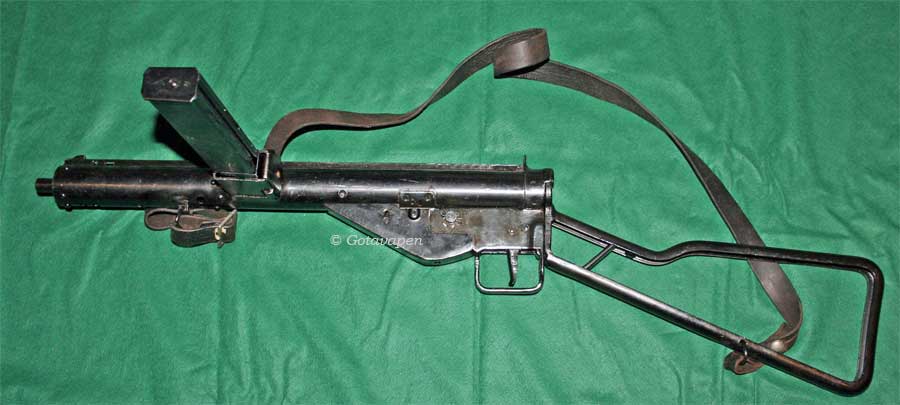
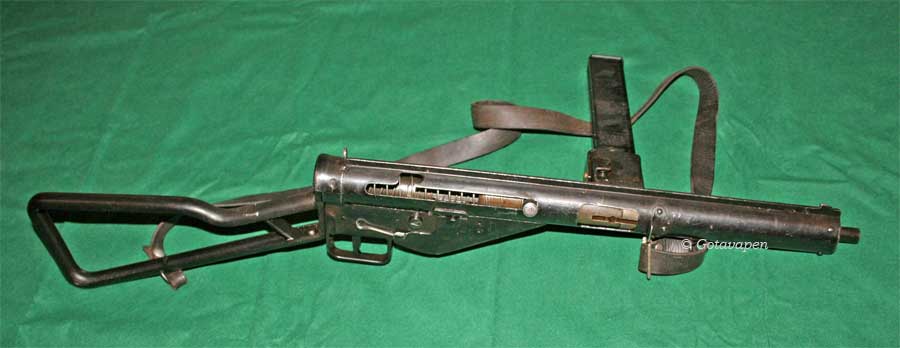
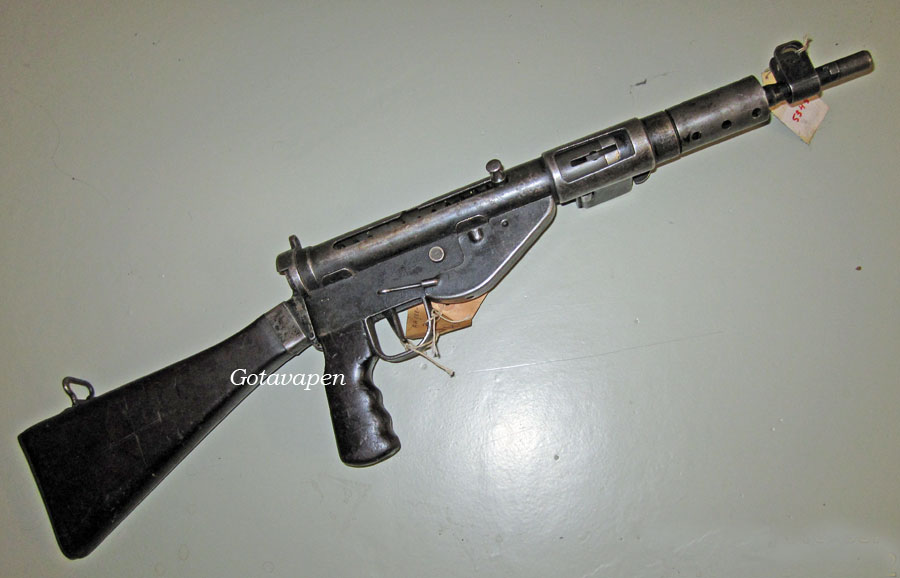
The Sten gun
filled the need of UK during the war for a cheap, easy made submachine gun.
The Stens were made by millions by many manufacturers. BSA made 400 000 +
Stens.
The basic Sten
gun was developed at Enfield by R,V. Shepperd and H.J. Turpin.
The name Sten is
derived from the first letters of their names and the first two letters of
Enfield.
Submachine guns
are very suitable to combine with silencers. The silencer for the Sten gun
was first developed in 1942, and was put into action in 1943. It is known
that it was used to kill the Norwegian traitor, Ivar Grande, in 1944. The
Sten gun was dropped in large numbers to the partisans. It was so easy to
build that only the barrels were dropped to the partisans and they then made
their own Stens.
The Sten was such
a practical construction that even the Germans started to make these
submachine guns at large numbers and equip their soldiers with them. The
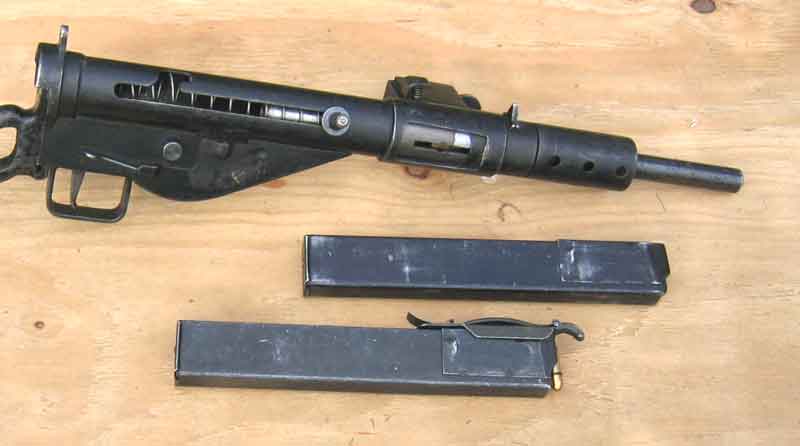
magazine was the weak point oft the Sten. The mags were sensitive to dirt
and could not be loaded completely because of the high risk of malfunction.
The Swedish Submachine Gun Carl Gustaf m/45 is a more exclusive copy of this
gun except for the magazine.
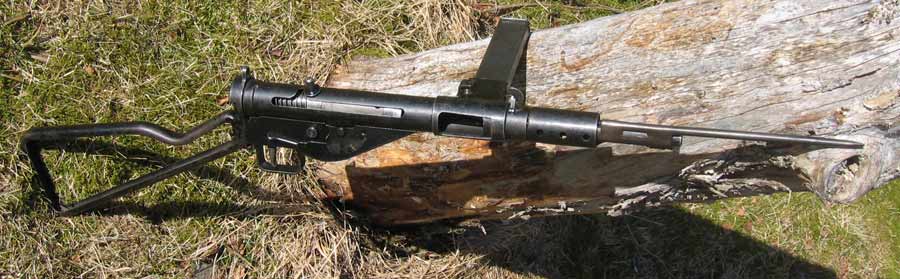
Sten
Mk 2
|
 |
|
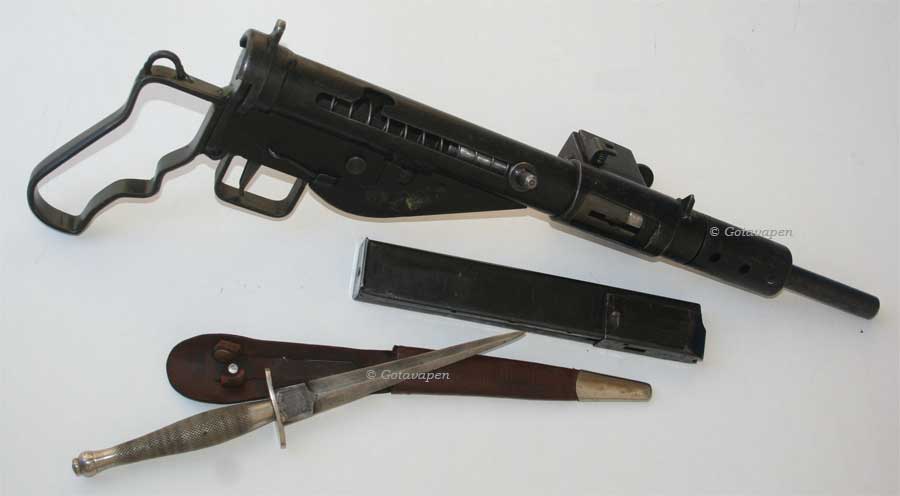
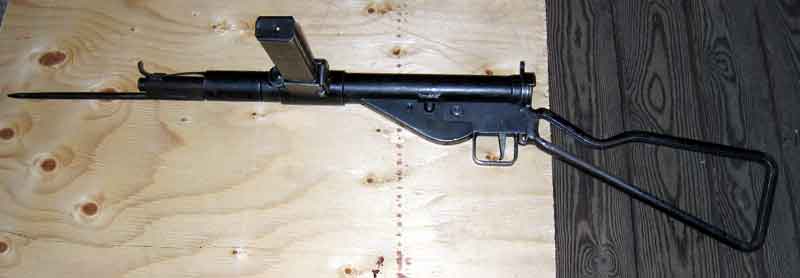
Sten
Mk 2 with the
very rare bayonet bayonet. |
|
 |
|
Sten SMG:s
were used by many resistances movements like this one from Norway.
This Sten has a very popular pistol grip instead of
shoulder stock.
The knife is
Fairbairn-Sykes Fighting knife 1st Pattern. |
|
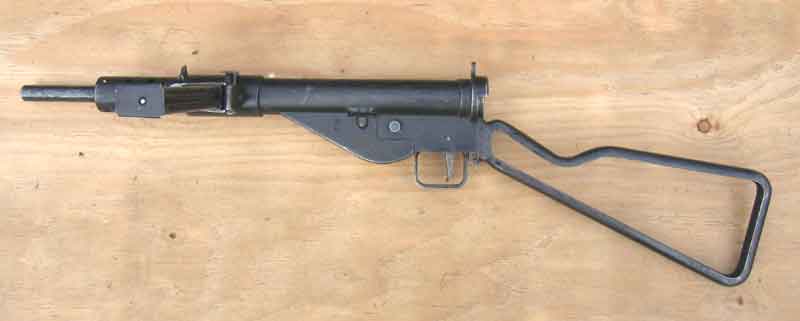
Sten
Mk 2 |
|
 |
|
Sten Mk 2 |
|
 |
|
 |
|
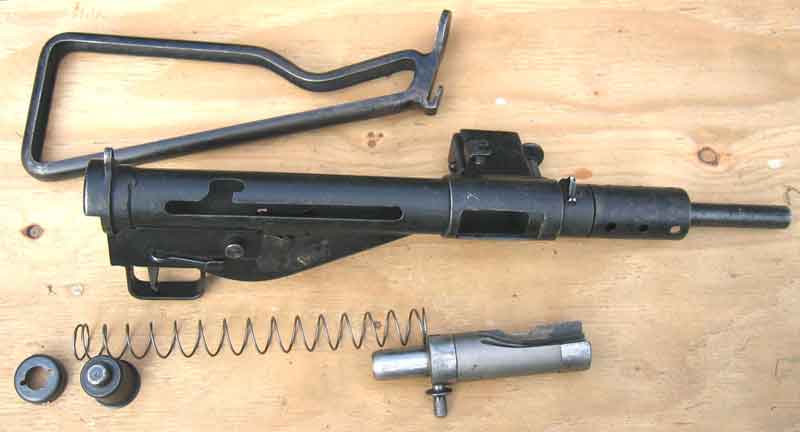
Here you can see the
Sten Gun Mk 2 with its bolt removed. |
 |
|
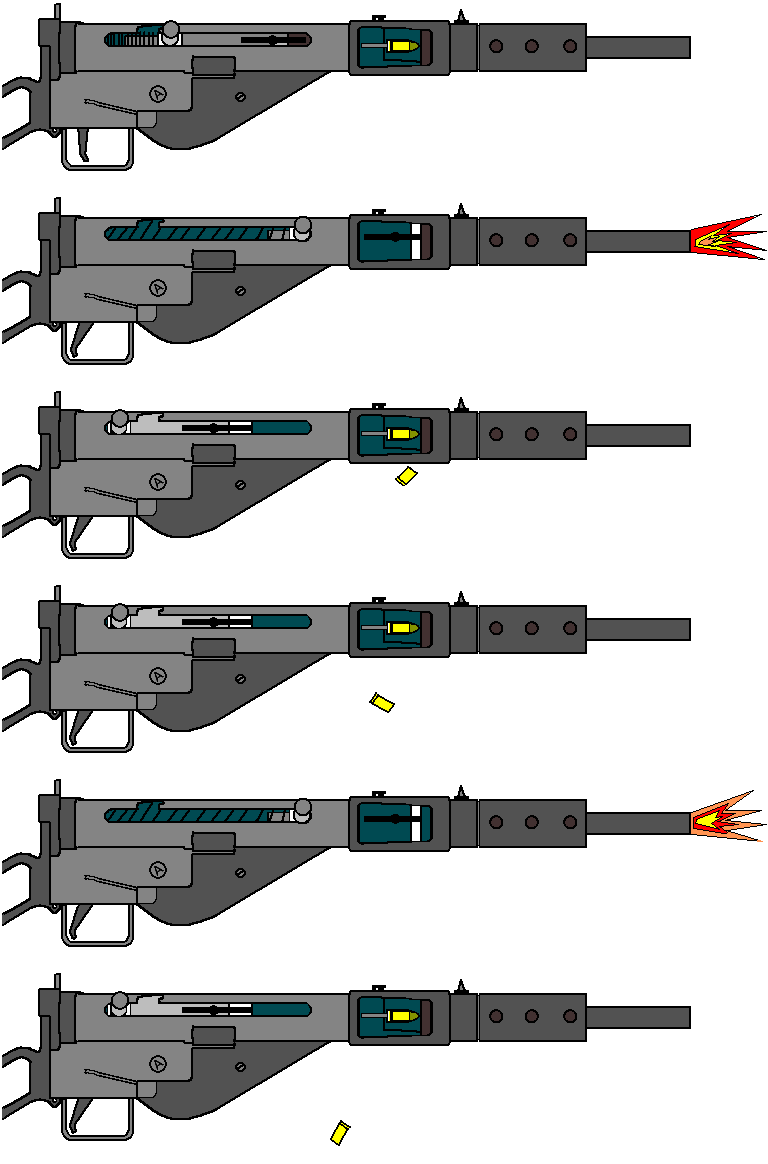
Here you can see how Sten Mk 2 is working. |
|
|
|
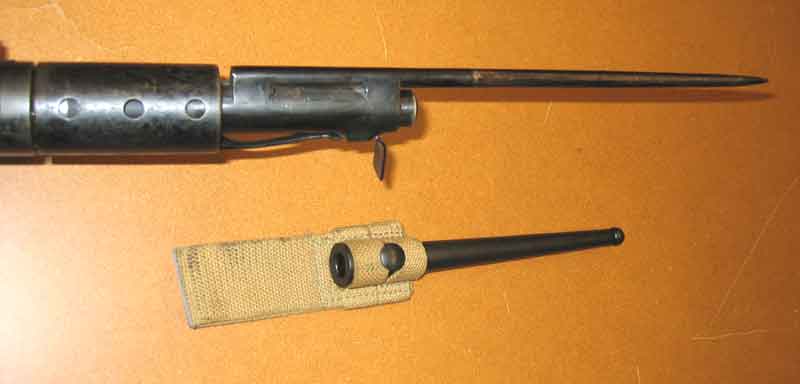
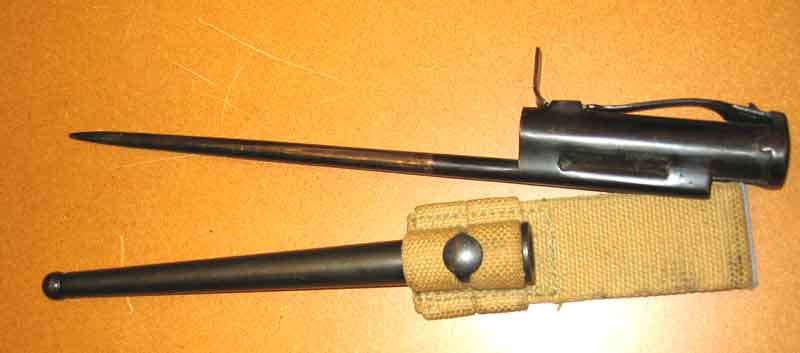
The extremly rare original Sten bayonet. (Be aware of fakes!) |
|
 |
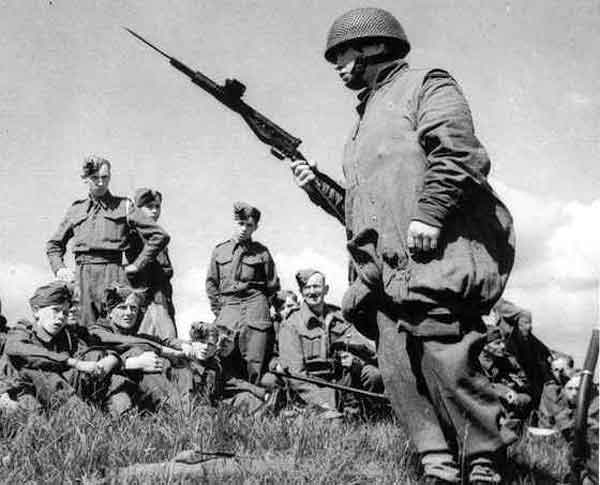 |
British home Guard
training
with Sten Mark 2 and bayonett. |
 |
|
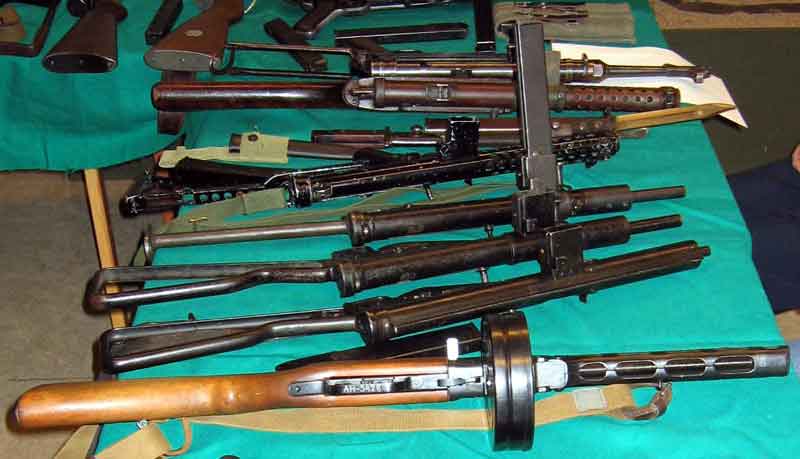
Above: Apart
from the Ppsh41 in the front, some submachine guns from UK. |
Post War SMG
|
|
 |
 |
|
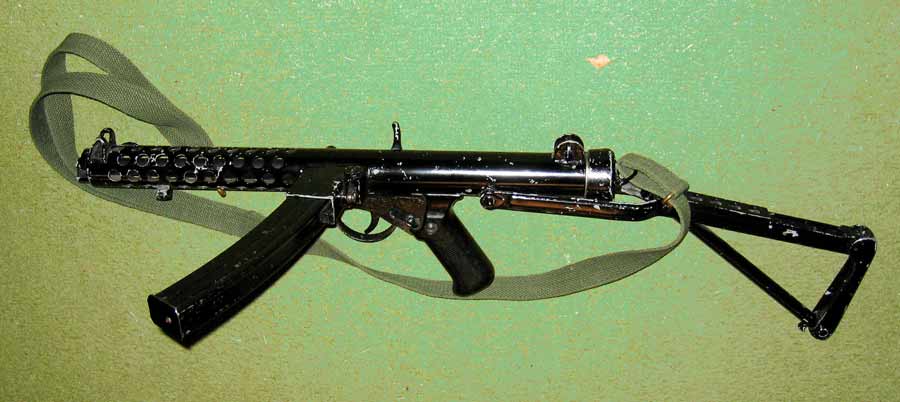
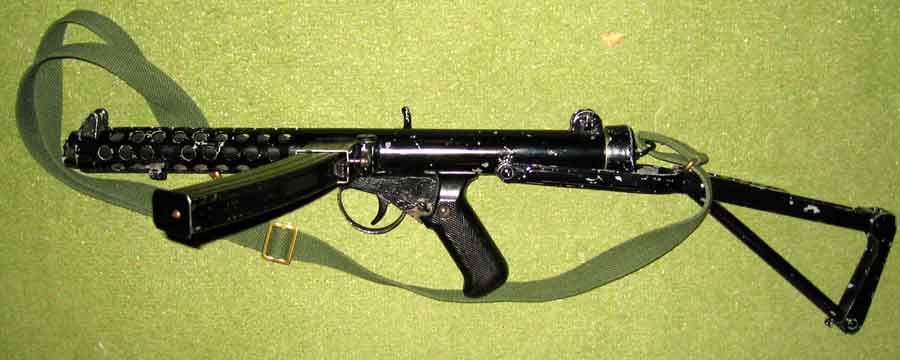
Here is a
Sterling or Patchett gun.
It was
developed by G.W. Patchett towards the end of WW2 at Sterling Engineering
Company of Dagenham in Essex. 1951 it was adopted and delivered in 1953 as
Submachine Gun L2A1. Sterling was adopted by New Zealand, Canada, India
and several other countries in the Commonwealth beside from UK.
There is a
silenced version of this gun called L34A1.
|
|
References:
Colonel (retired) Axel Ekfeldt,
who built the wonderful collection of Vapenmuseet in Eskilstuna
Small Arms of the World, Joseph E.
Smith and W.H.B. Smith 1967
Ian Hogg & John Weeks, Military small
arms of the 20th century,
Töjhusmuseet, Köpenhamn
and my friends in our collector's
association |
[Top
of the page]

|