|
Text and pictures by
(Picture to the right: |
|
updated 2008-12-30
Three Patterns
|
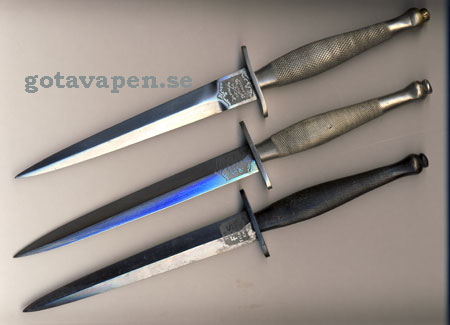
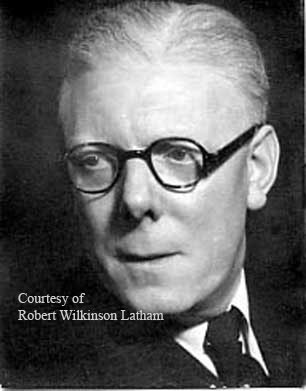
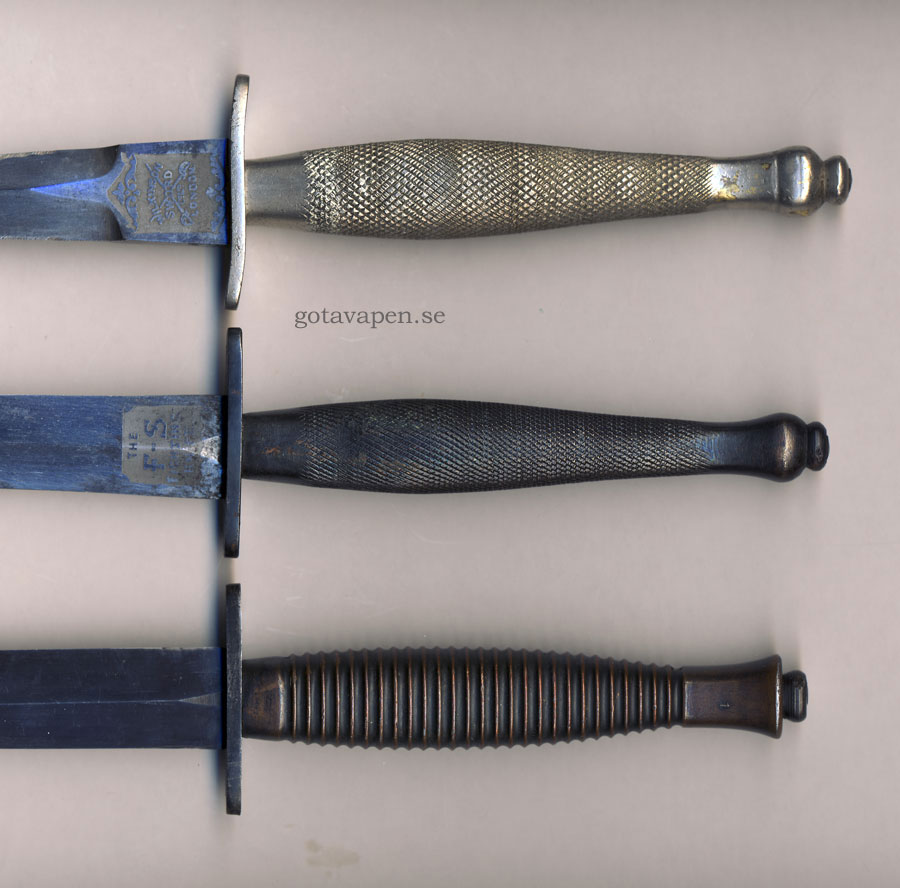
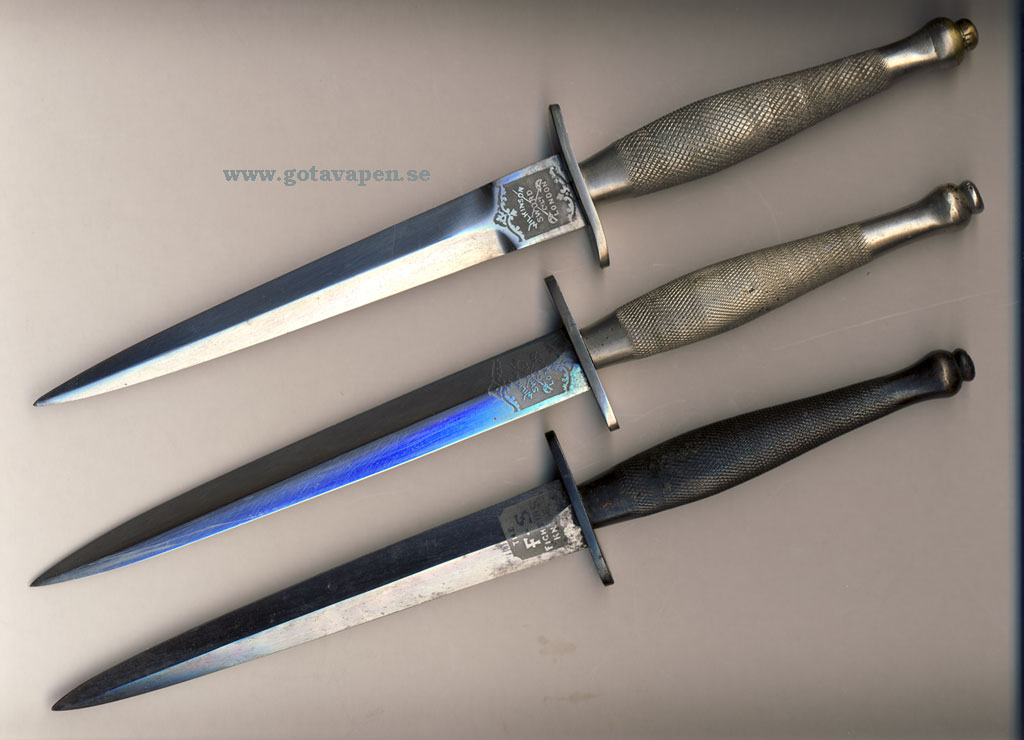
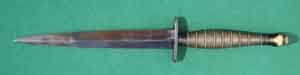
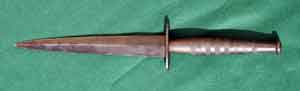
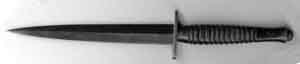
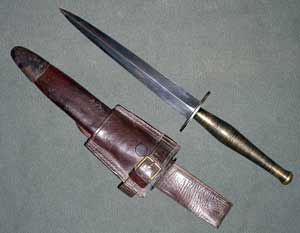
There are three well known standard types of Commando knife – these are called First (1940) with 3" and 2" cross-guard, Second (1941) and Third Patterns (1942 to present). This was well documented by Robert Wilkinson-Latham in his article in the magazine "Antique Arms and Militaria"
Beside the three main Patterns there are many variations. Some of these variations are well known like the "Beaded and ringed" while other might be more difficult to categorise. |
![]() |
|
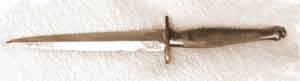
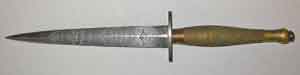
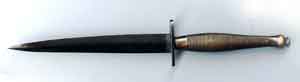
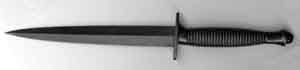
From top to bottom: Pattern 1; Pattern 2 and Pattern 3 |
The First Pattern.

|
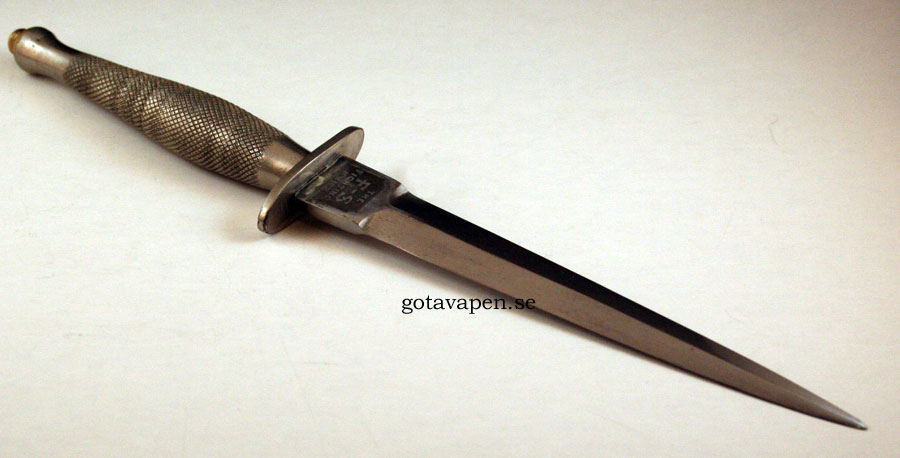
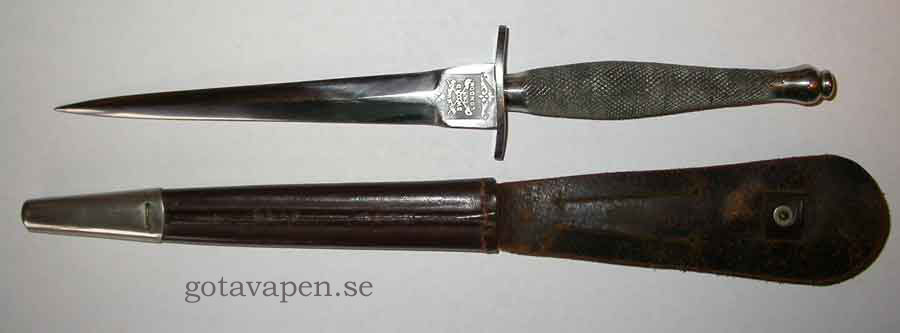
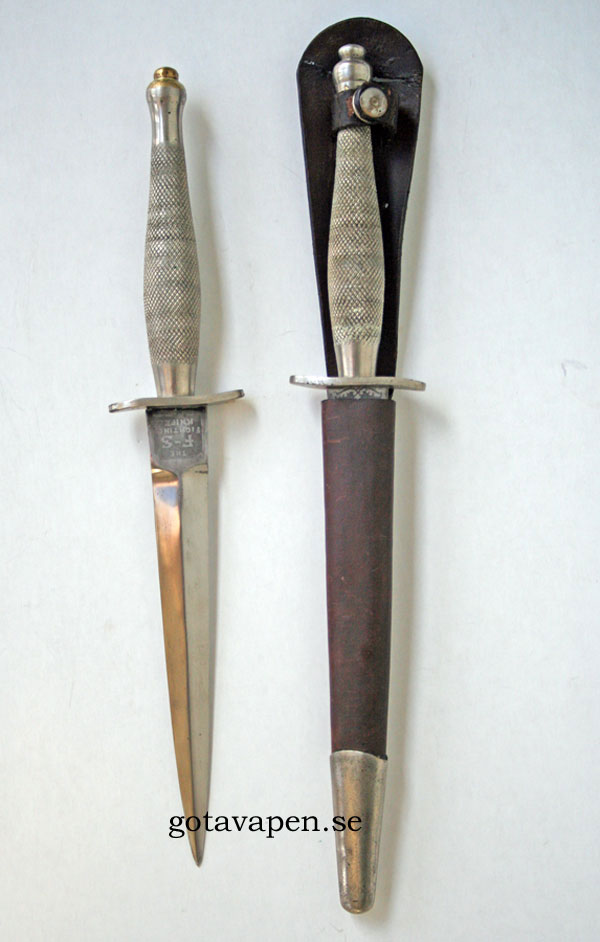
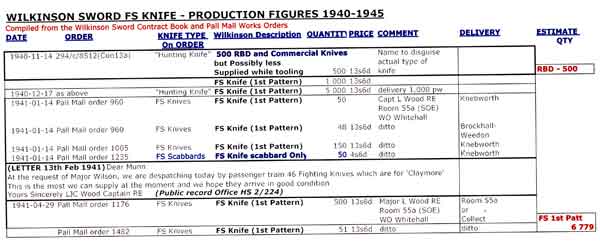
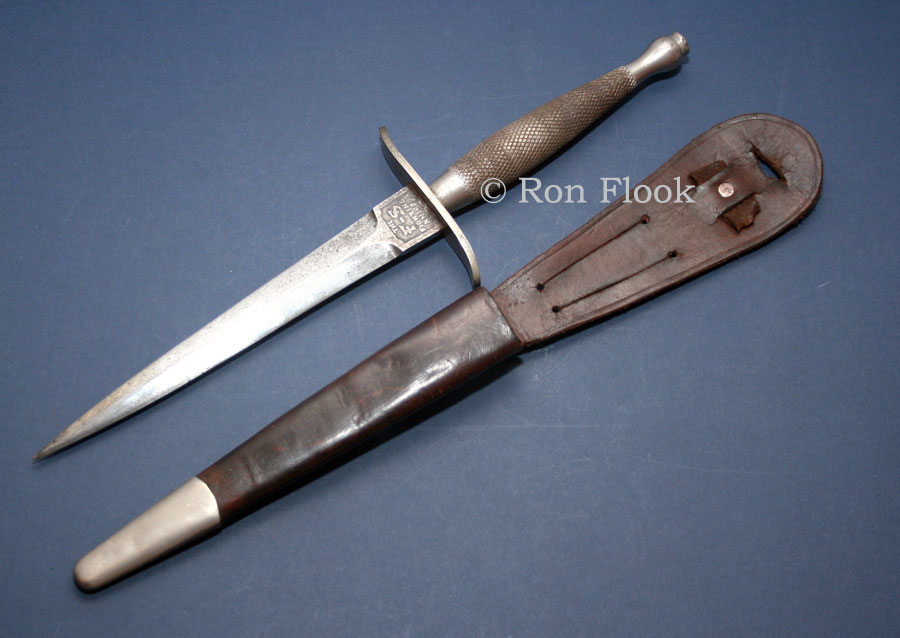
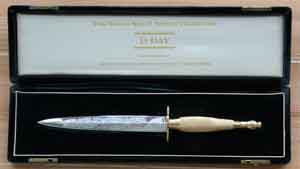
The very first 1st Pattern F-S Fighting Knives were made in November 1940. In January 1941the full war full production started, according to Robert Wilkinson Latham. The grip was made from solid brass and cut by 16 lines per inch in a diamond pattern. The grip and hand guard were nickel plated. The hand guard was curved to S-shape. The blade was grounded by hand. For this reason it is difficult to find two blades of exactly the same size and shape. This model was produced in very limited numbers.
The very first 1st Pattern Wilkinson
Sword F-S knives were ordered the 14th of November 1940. Order 294 mentions
500 'RBD and Commercial knives' but possibly less. They were called in this
way in the order to disguise the actual type of knife.
The 1st Pattern
was delivered from November 1940 until April 1941. 17th of December 1940
5 000 “hunting knives” were ordered. This order concerned the first 1st
Pattern knives. Price for each was 13 s 6d. All together 6 779 -
1st pattern were made according to Robert Wilkinson Latham. |
![]() |
![]() |
|
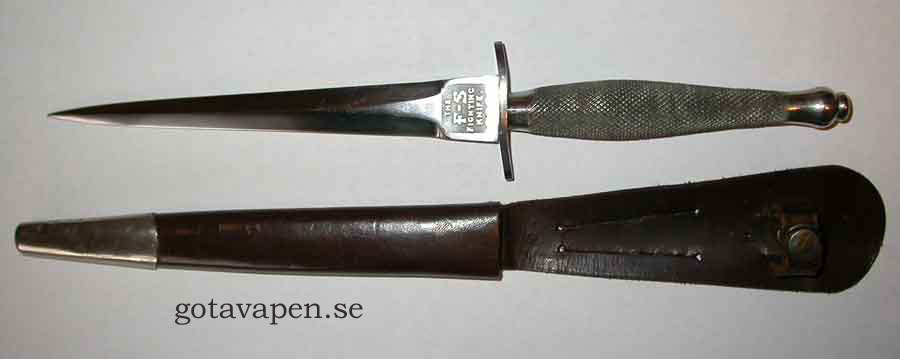
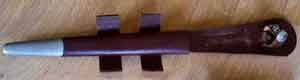
Here is the 1st Pattern with 2 inches cross guard. (Photo by Roy Shadbolt) The scabbard without wings (leather tabs) on this early scabbard. |
|
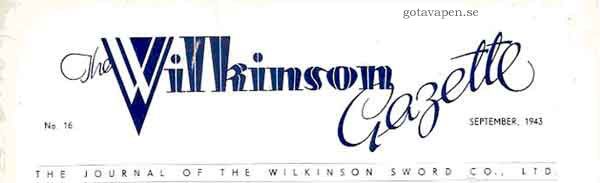
The first order for proper F-S knives, with new tools, was made 17th of December 1940. This order was marked “Hunting Knives” to disguise the actual type of knife. This was told by the Forman Jack Mappin. In The Wilkinson Gazette 1943 September issue it is told that he grounded the 1st Pattern F-S knives and also the Stalingrad Sword. He started to work for Wilkinson 1914 as a grinder. 1932 he was made Forman of the mill. (Courtesey of Robert Wilkinson Latham) (For more information about the Stalingrad Sword – please visit the special page about this Sword.) |
![]() |
![]() |
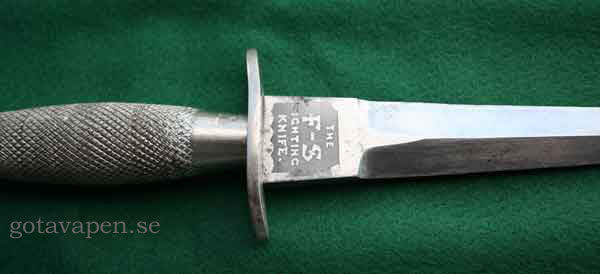
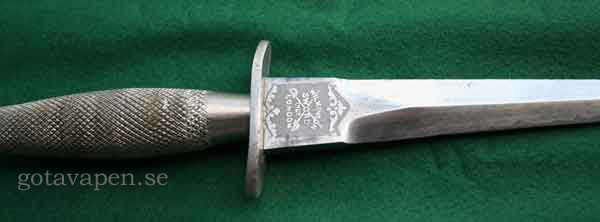
On one side and
|
|
![]() |
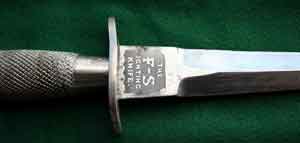
on the reverse appears Wilkinson's trademark: WILKINSON SWORD CO LTD LONDON,
|
|
|
Here are two
1st
Pattern (Private collection) |
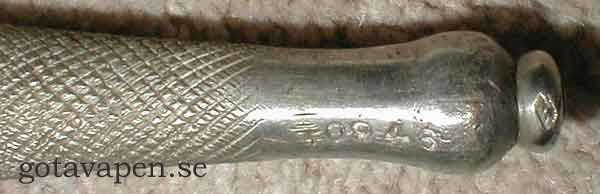
Regarding Numbering on grip near the pommel.
|
|
There are grips of 1st Pattern knives with numbers like this one. Gordon
Hughes the author of |
|
These numbers are most likely stores marks according to Robert Wilkinson Latham He told me that serial numbers were never stamped near the pommel by Wilkinson. According to the sword makers he talked with, who made these knives, they would never stamp articles in such an erratic and untidy fashion over the nickel-plating. Robert Wilkinson Latham says that the marked knives never were issued for combat, but only for training. When the soldier had finished his training he was issued a ‘chit’ for a knife which he collected from Wilkinsons at 53 Pall Mall London. |
![]() |
Production
Figures 1st Pattern (Courtesey of Robert Wilkinson Latham) |
| Specifications for First Pattern | ||
|
Length over all |
11.6" - 12.1 " |
290 - 306 mm |
|
Length of blade |
6.5" - 7" |
160 - 175 mm |
|
Wheight |
230 - 270 gram |
230 - 270 gram |

![]() |
|
Here is one 3” handguard variation. Picture with courtesy of Tom Parker According to Robert Wilkinson-Latham there are no proofs that WSC ever made any F-S knives with 3” wavy cross-guards! There are no documents or drawings of such a knife. The original Wilkinson Museum at Southfield Road, London, W3 from 1920 until 1970 never had such a knife in their collections of F-S knives. It is not likely that such experienced experts like Cpt W.E. Fairbairn and Cpt E.A. Sykes would have foreseen such an error in design like a wide 3” cross guard which would snag in the clothes when drawn or even worse get stuck in the clothes of the enemy when used. The 3” wide cross-guard started to appear during the 1960’s. It is up to the collector to draw his own conclusions. |
|
Ron Flook who is of a different opinion says: "The 3 inch is real but it is unfortunately a variation whose story has been messed up by the problem of fakes." If you want to read more and see his picture please go here>>> |
![]() |
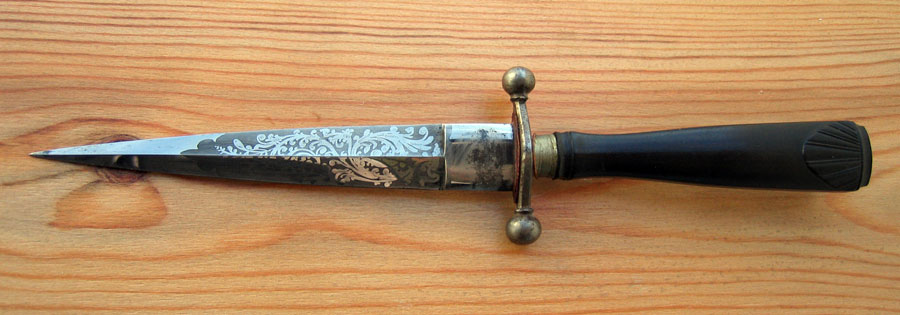
Here is a hand made knife out of a M1903 bayonet. The part nearest to the crossguard was used and the ricasso still remains from the bayonet. The tip of the bayonet became a thumb-knife. These two knives are NOT made by Wilkinson Sword Co. The authenticity of this knife is however questioned. This knife might be a pre-production F-S Fighting knife. |
Agents Knives
|
There are also some smaller commando knives which are called Agent commando knives. Very little is known about them. Robert Wilkinson Latham has told me: Wilkinsons did NOT make these knives and NEVER marked knives with WSC. The only stamp Wilkinsons had was:
This All in One stamp was ONLY used on 1907 bayonet and No 5 bayonet blades. There are also reports of shortened WS F-S knives. We must remember that there was a war going on and nothing which still could be used was thrown away. For this reason some broken knives were regrounded and resharpened to that extent that today they might be mistaken for what collectors call agents knives.
|
![]() |
Here are two of these knives. The top of agents knife with a hilt of brass is marked WS .The second knife with black hilt was made by A & P (Alcock & Pierce) of Melbourne Australia, it is marked ‘MARS’ so is attributed to the ‘Mars Task Force’ OSS Burma. (Photo from Roy Shadbolt)
|
![]() |
A & P
stands for
Alcock
&
Pierce,
|
![]() |
![]() |
| MARS’ is attributed to the ‘Mars Task Force’ OSS Burma. |
![]() |
Forming of Commandos |
![]() |
The Shanghai fighting knives |
|
There are three basic modells of the F-S fighting knife. |
|
|
1st Pattern F-S Fighting knife |
![]() |
2nd Pattern F-S Fighting knife |
![]() |
2nd Pattern F-S Fighting Private Purchase knife |
![]() |
2nd Pattern F-S Fighting w/o Wilkinson
trademark. like B2, Fat Man, Reverse Knurling |
|
3rd Pattern F-S Fighting knife |
![]() |
Beaded & Ringed - Roped & Ringed |
![]() |
|
|
Wood handles. |
![]() |
OSS -
Stiletto w.'Pancake Flapper' and |
![]() |
|
|
|
|
![]() |
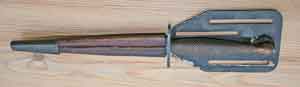
Sheaths |
![]() |
Marks |
![]() |
UK Commando knives; Postwar production |
![]() |
The Stalingrad Sword made by Wilkinson Sword. |
|
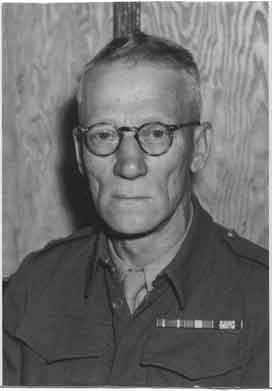
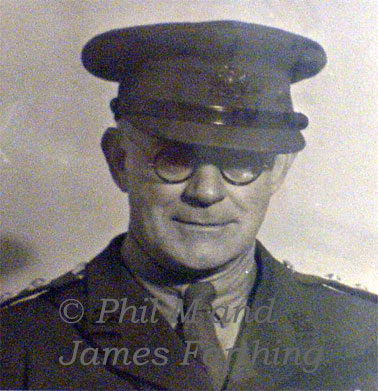
I want
to give special acknowledgement to these gentlemen,
|
References:
| Robert Wilkinson Latham | His own web site |
| Alan W. Locken | Commando 1940 - 1945 |
| Robert A. Burlein | Allied Military Fightingknives |
| Ron Flook | British and Commonwealth military knives. |
| Fredrick J. Stephens | Fighting Knives |
| Frank Trzaska | The O.S.S. Stiletto - Knife World February 1998. |
| Frank Trzaska | The Raider Stiletto - Knife World July 1997 |
| Kelly Yeaton | The First Commando Knives. |
| John Nowhill & son | Sheffield |
| Michigan knives | |
| Dr. William Windrum | The earliest commando knivesAllan W. Locken – Commando 1940 - 1945. |
|
Back to in Swedish
|