|
Swedish Military Rifles 1894 - 1995
Text O. Janson
up dated
2024-04-20
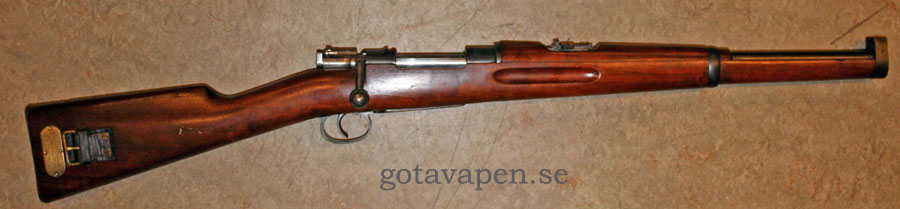
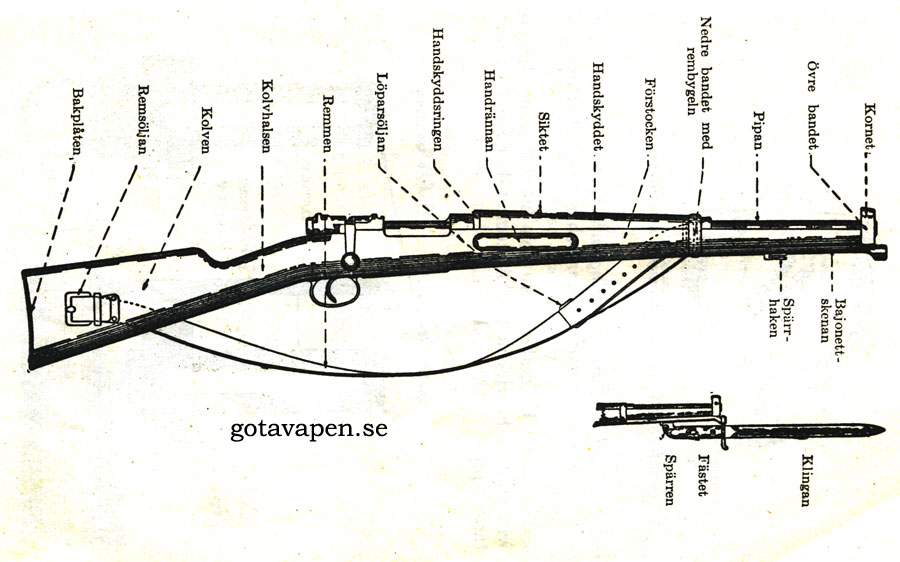
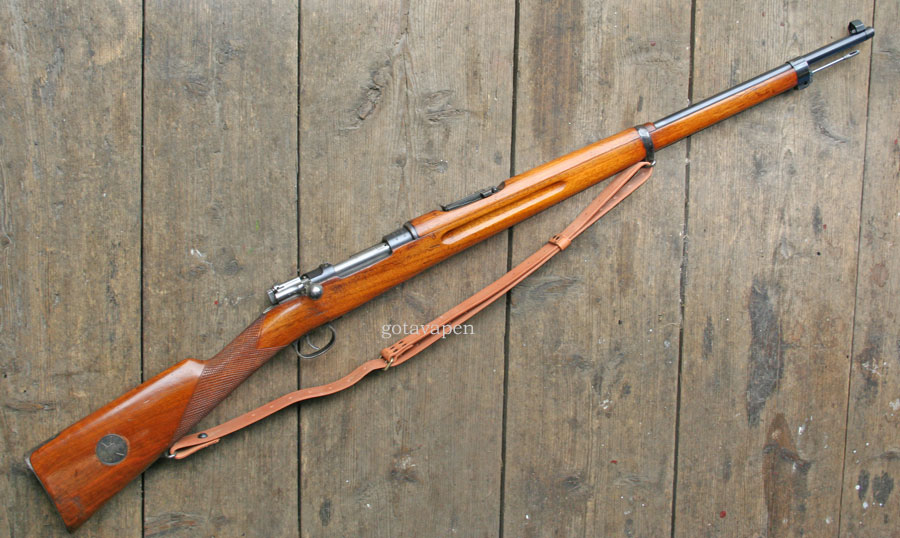
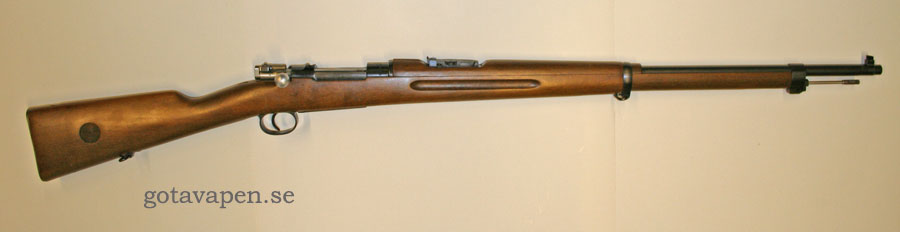
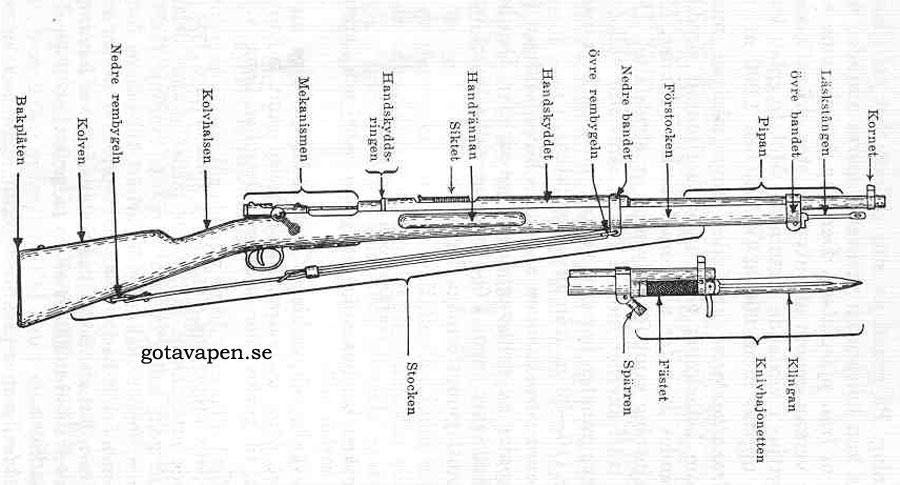
Carbine m/1894 and m/1894-1914
(K m/94 & K m/94-14)
|
 |
|
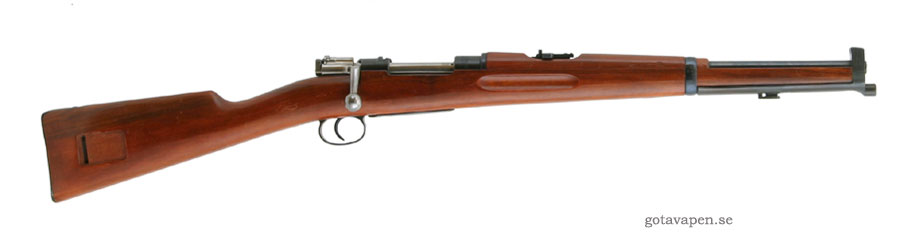
Carbine m/94-14 or M/94-14 (with
bayonet lug) |
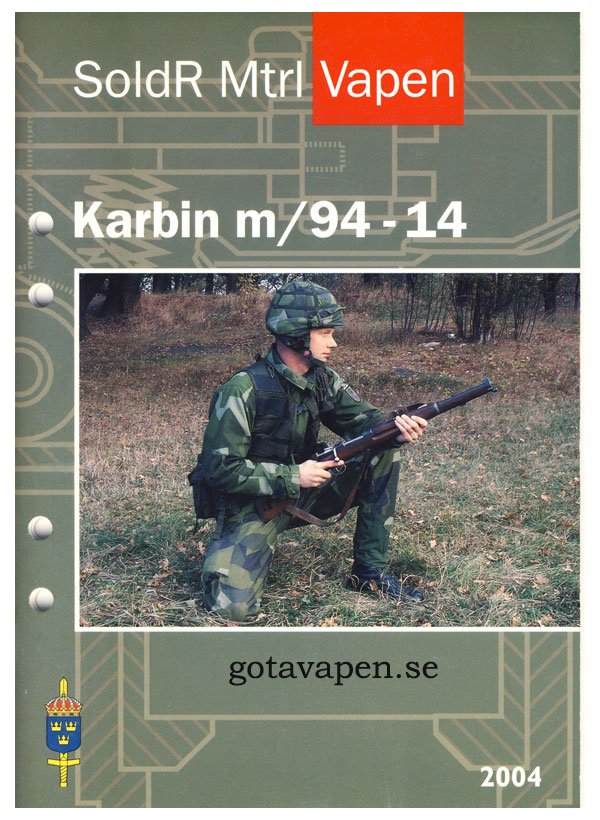 |
Carbine m/94-14 is still in use
for parades. Here is the resent
Instruction Manual for the Army 2004. |
| Karbin
m/94, K m/94 |
| Calibre |
6,5×55 |
| Ammunition |
6,5 mm m/94 |
| V0 |
655 m/s (ammo m/94) |
| 730 m/s (ammo m/41) |
| Feed |
5-round integral, double row magazine |
| Design |
Mauser, model 1893 |
| Action |
Bolt action |
| Manufacturer |
Mauser |
| GF |
| Year of delivery |
1895-1918 |
| Quantity |
Mauser ≈10 000 |
| GF ≈11 5000 |
| Barrel |
449 mm, 4 grooves |
| Length |
950 mm |
| Weight |
3,4 kg |
| Sights |
200-1600 m |
| Miscellaneous |
Same action as G
m/38 |
| Similar action to G
m/96. |
| Status |
Obsolete |
| Some converted to Gevär
6 and Gevär
7 |
|
 |
|
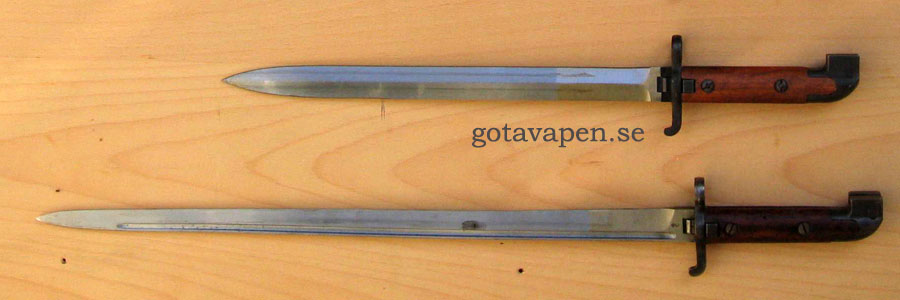
The
main difference between Carbine m/94 (M/94 for Navy) and m/94-14 is the
bayonet lug. There were two different bayonets issued depending upon the
branch.
-
The shorter bayonet called m/1914 and was basically used by Cavalry and
horse riding troops.
-
The longer bayonet called m/1915 and was basically used by the Navy.
|
[Top of the
page]
Rifle m/1896
| The m/96 rifle used a short knife bayonet with a hollow steel handle, called
the "bajonett
m/96" - though it was actually not adopted until the summer of 1897.
Early rifles have stocks cut from walnut.
Rifles made during WW1 have stocks cut from birch, elm or mahogany.
Rifles manufactured later got stock cut from copper beech.
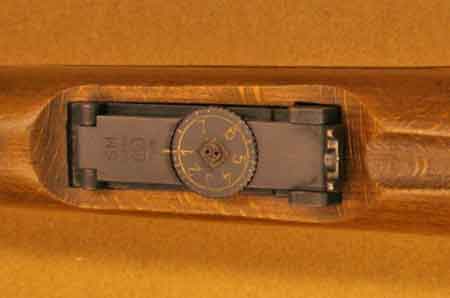
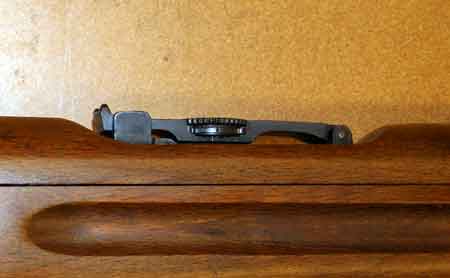
The m/96 rifle used a triangular front sight post and a rear leaf sight with
a V-shaped notch. When folded down the rear sight is graduated from 300 to 600
metres, in 100 m steps. When flipped up it is graduated from 700 to 2000 metres.
A rifleman never used the flipped up position on his own - it was only used for
simultaneous fire at ranks of enemies. The width of the leaf at the axle-end is
11 millimetres.
In the 1940s the front sight was changed to a new m/41 rectangular post. The
m/41 front sights are available in 9 different heights, from -1 to +3
millimetres in 0,5 millimetre increments.
At the same time the rear sight was altered to have a U-shaped notch. The
Armourers had to remove the sight on every rifle and place it in a special jig,
then file the sight notch to the new shape and refit the sight. The rifles were
then sighted in - spot on at 300 metres using the pointed m/41 ammunition. The
height of the correct front sight post was stamped on the left side of the front
sight base, and a "T" on the right side (T for "Torped", which means a pointed
boat-tailed bullet like the m/41).
After this modification the flipped up position was never used.
According to my father who made his
military service 1935, they used special poor rifles for training
exercise and parade, but when they went to the shooting range the guns
were exchanged for other better guns for target practice. These better
rifles had the ordinary brass discs contrary from the exercise guns.
The Army's intention was to equip all m/96 rifles with a SM sight, calibrated
for the m/41 "torped" ammunition. Trails were made with the "SM sikte F ram", but for some reason this minor modification was never carried out.
However there were several civilian SM sights, including a nickel-plated SM
micrometer sight to be inserted in the ordinary sight ladder. This one is quite
similar to the "SM sikte m/38" used on the type I m/38 rifle, only difference is
markings on elevation knob. The insert micrometer sight for the m/96 rifle is
graduated from 100 to 750 metres and is calibrated for civilian pointed
ammunition.
There was a civilian production of the m/96 as well. The rifle organization
"Frivilliga skytterörelsen" (FSR) ordered some 20000 m/96 rifles from Husqvarna
in the beginning of the 1940s. (1940-1943 circa)
These rifles were made to the same specifications as the armys m/96 rifles and
the production was partly financed by the Crown. They were sold to members of
the "FSR" at a low cost (200 kronen) on the condition that the owner would sell
his rifle back to the Army in case of total mobilization.
About 5000 of the FSR-rifles used a new m/43 leaf sight in 50 m intervals from
100 to 600 metres, and 100 m intervals from 600 to 800 metres. The sight ladder
is stamped "1", "2", "3", "4", "5", "6" and "8" on the left side, and with index
lines for 50m and a "7" on the right side.
About 12000 of the FSR-rifles used a sight called the AGJ-sight made by "A. G.
Johanssons Metallfabrik AB" in Västerås. The AGJ sight is marked "SM sikte agj-ram" and looks very similar to the later "SM sikte m/55" used on the m/41
snipers rifle.
|
The brass disc.
|
Swedish |
English |
|
Torped |
Bullet with boat tail (also means "torpedo") |
|
Överslag |
"Point of impact over line of sight" (also
means "estimate") |
|
STR = Streck |
Mills (1 Swedish mill = 1 meter at 1000
meters = 3,6" at 100 yds) |
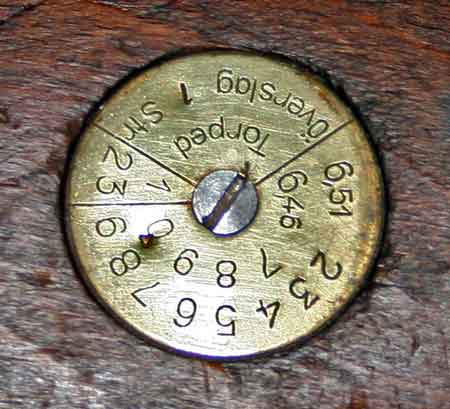
The largest sector is stamped with the calibre of the barrel.
The m/41 round had a much flatter trajectory than the older m/94. As
most rifles were already manufactured with iron sights for the "m/94
bullet", the aiming correction in mills (how much lower you had to aim
to hit the target) was inscribed on the brass disc. This is the
information in the second sector. It was usually 0.5 mill.
The last sector gives information on the level of bore pitting. “1”
means pitting in the groves. “2” means pitting in the
groves and on the side of the lands. “3” means pitting in
the whole bore (which means unserviceable). A rifle would never receive
a “3”. It would instead be turned in to a work shop, where the old
barrel would be exchanged for a new one.
|
[Top of the
page]
Gevär
fm/1923
Test rifle
|
Test
rifle
|
Length over all |
1 125 mm |
|
Weight |
4,1 kg |
|
Calibre |
6.5x55 mm |
|
Barrel |
Heavy round barrel 750 mm |
|
Bolt handle |
Straight or bent |
|
Sight |
Diopter Lyman patent Model 48M |
|
Round capacity |
5+1 cartridges |
The barrel
was round at the rear end the diameter was 295 mm and at the front
210 mm. The front sight was a post or a ring sight surrounded by a
1cm long cylinder of steel with an inside diameter of 15mm. The
Lyman dioptre was set from 100m to 1 000m. The striker lacked the
thumb hold and was shorter for faster ignition. The stock was a
straight English type like m/96 but only half way of the barrel. |
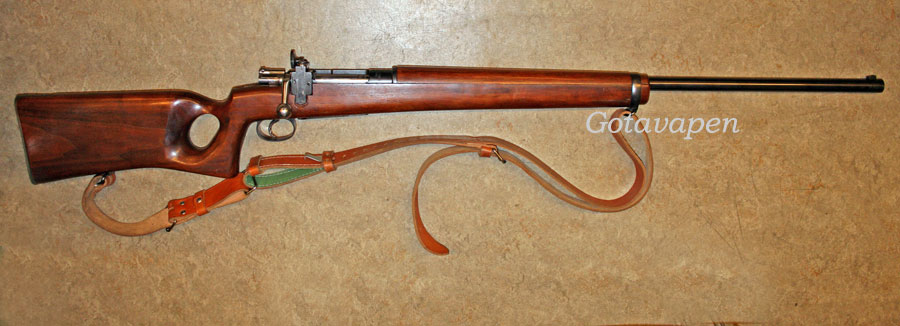
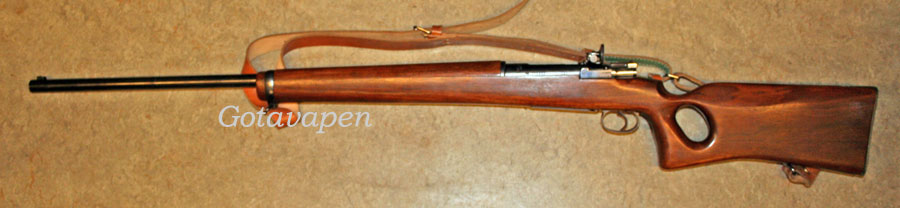
Gevär fm/1923-36
Test
rifle
 |
 |
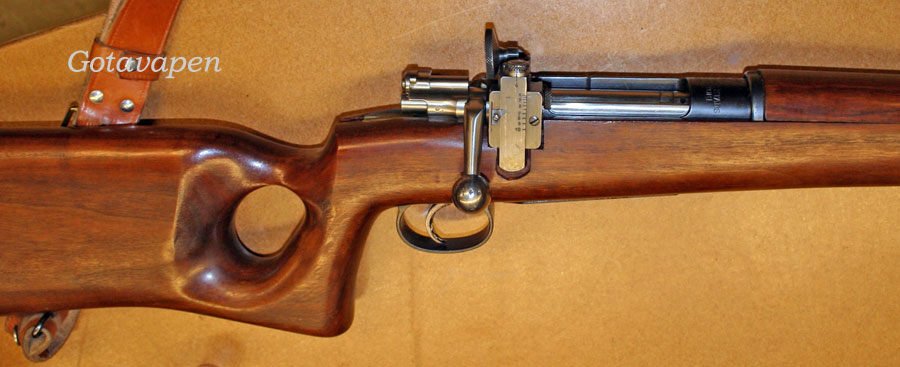 |
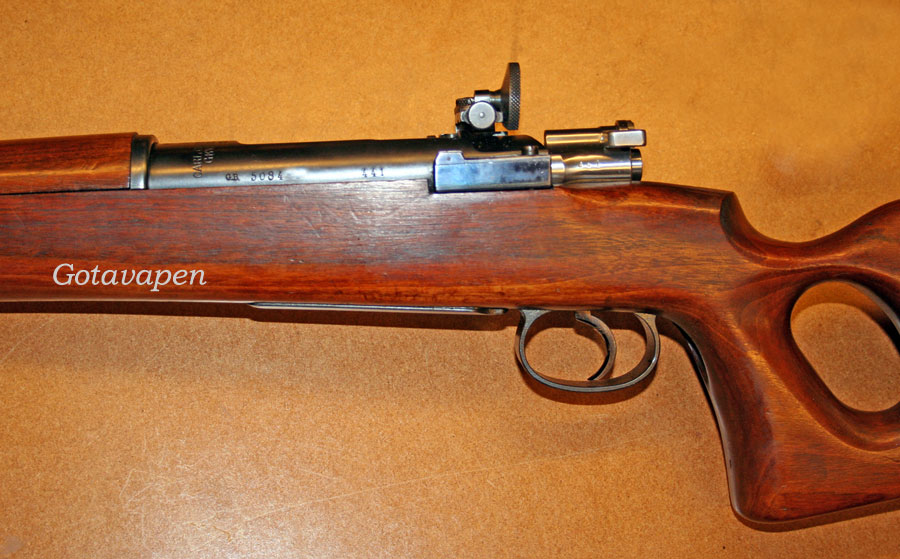 fm/1923-36
Note stonger receiver without recess for thumb.
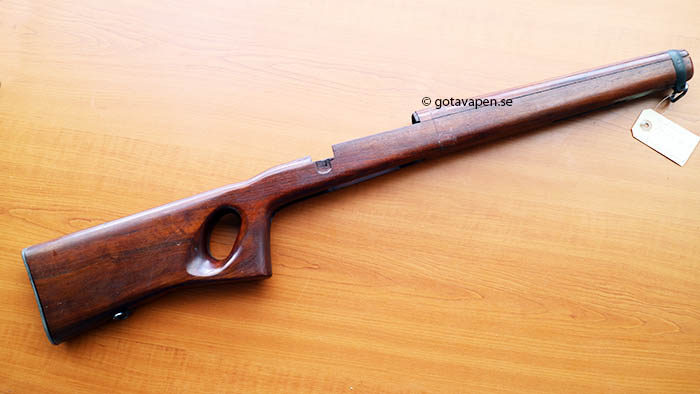
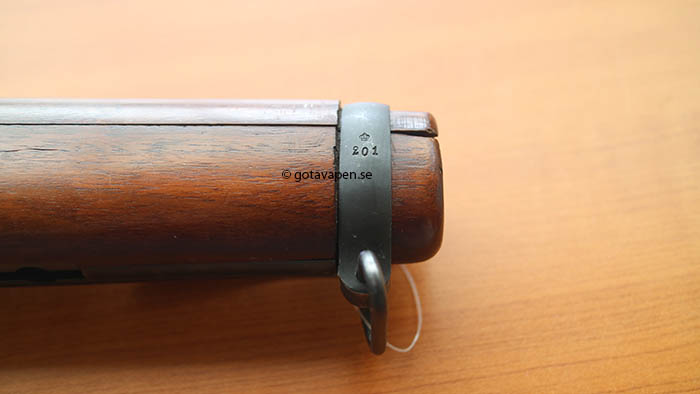
The
Wooden stock for the premature excellent rifle Fm/1924-36 in 6,5x55 mm with
original front band. |
|
|
Length over all |
1 260 mm |
|
Weight |
4.4 kg |
|
Calibre |
6.5x55 mm |
|
Barrel |
750 mm rounds |
|
Bolt handle |
Straight |
|
Sight |
Diopter Lyman patent Model 48M |
|
Round capacity |
5+1 cartridges |
This rifle
was very much the same as fm/1923 but with a thumb hole stock. The
receiver was stiffer and stronger because it lacked the recess for
the thumb on the left side.
|
[Top of the
page]
Prickskyttegevar
m/41 -
Sniper rifle
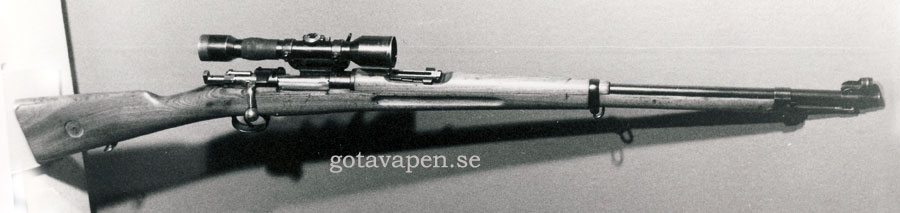 |
|
Sniper rifle m/41 with white and bent bolt and original rear sight.
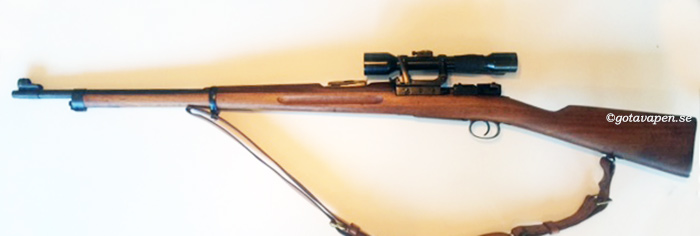
(Rifle m/41B with black
mechanism and different
sight and base for the scope.) |
|
| Gevär
m/41, G m/41 |
| Type |
m/41 |
m/41 B |
| Calibre |
6,5×55 |
| Ammunition |
6,5 mm m/94 |
| Feed |
5-round integral, double row magazine
|
| Design |
Mauser, model 1893 |
| Action |
Bolt action |
| Manufacturer |
Mauser
GF
(HVA ??)
|
| Year of delivery |
1941-1943 |
|
| Quantity |
5300 |
| Barrel |
739 mm |
| Length |
1260 mm |
| Weight |
|
| Sights |
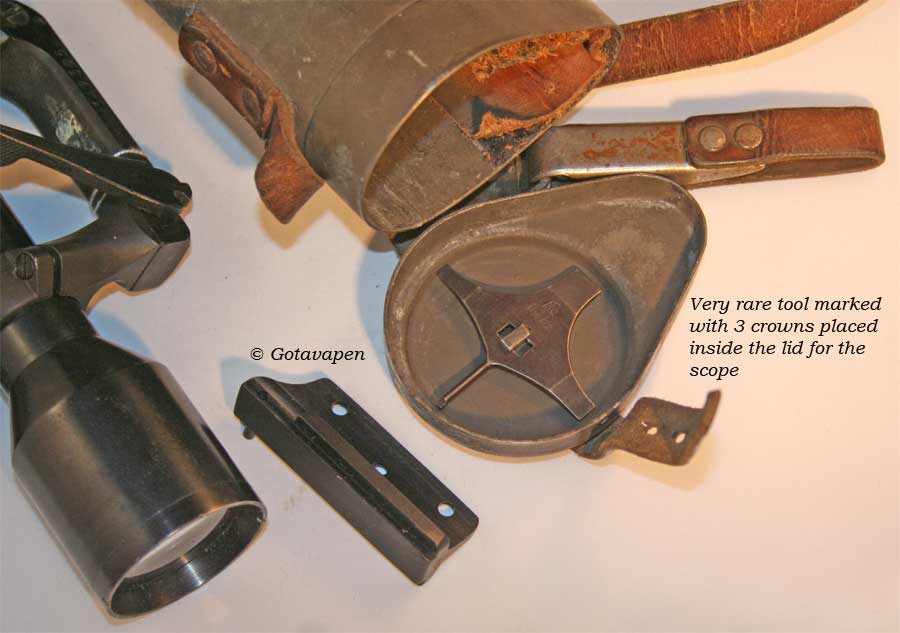
m/41 scope
m/42 scope
m/44 scope |
m/41
B scope |
| Miscellaneous |
Modified G
m/96 |
Mostly modified
G m/41 |
| Status |
Obsolete, sold |
|
|
Some figures about sniper delivered rifle
m/41 by Husqvarna Gunfactory |
|
Rifle m/96 with mounted scope delivered by
Husqvarna Gun Factory to Army units. |
| |
|
Day of delivery |
Number delivered |
|
23rd of March 1942 |
280 pcs m/41 |
|
27th of March 1942 |
20 pcs m/41 |
|
10th of August 1942 |
200 pcs m/41 |
|
24th of October 1942 |
360 pcs m/41 |
|
24th of October 1942 |
36 pcs m/41 without setting sights |
|
24th of October 1942 |
13 pcs only installed mount. |
|
 |
|
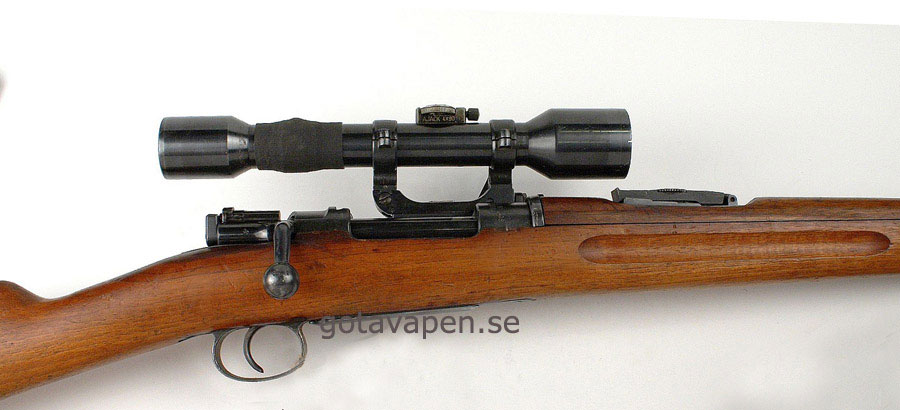
m/41
B scope - refurbished with black and bent bolt. |
[Top of the
page]
Swedish Sniper Rifle
scopes
|
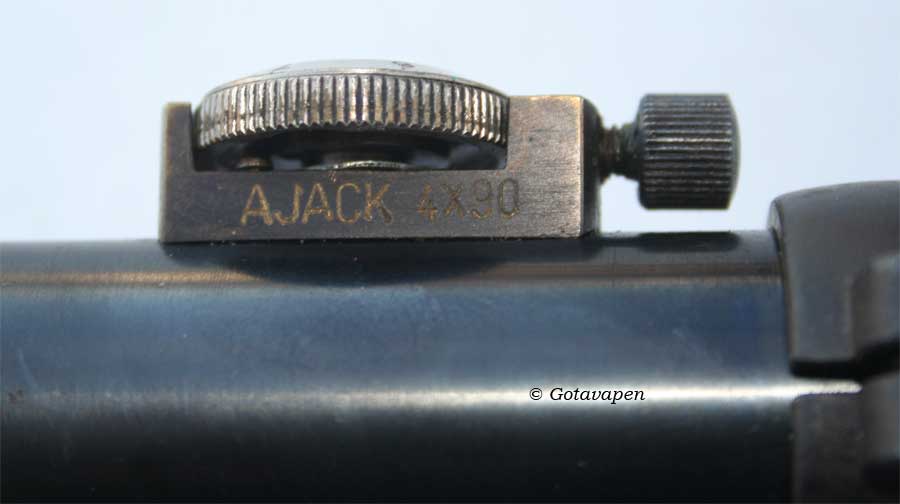
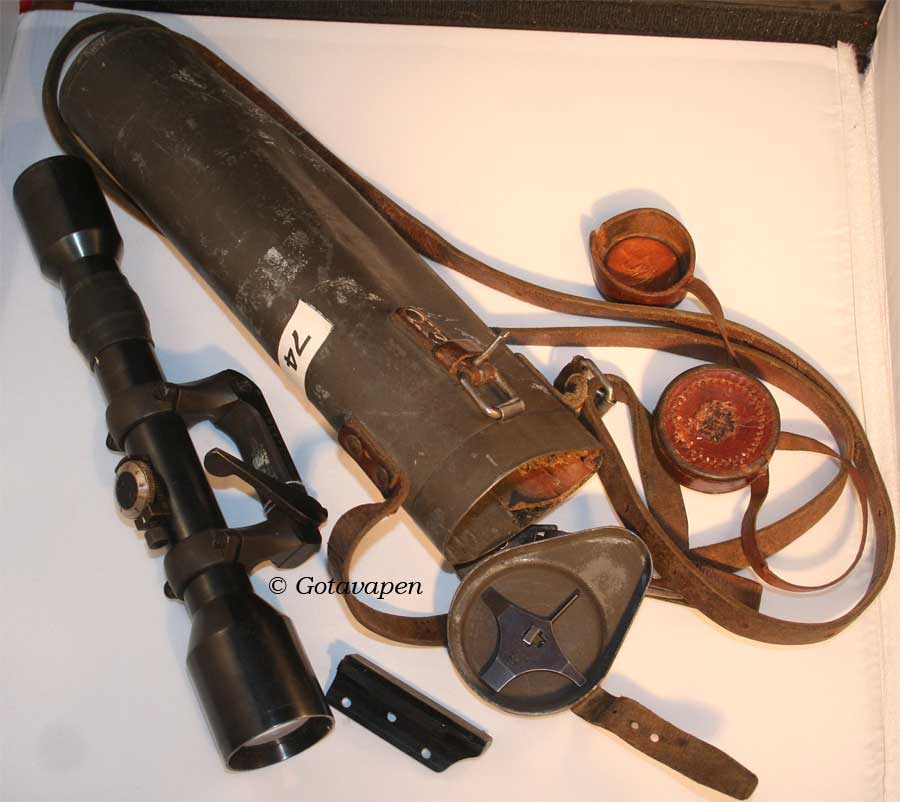
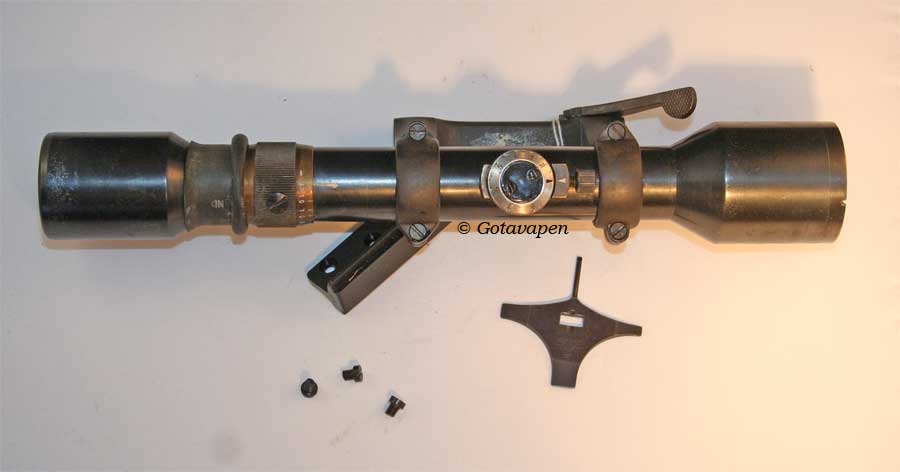
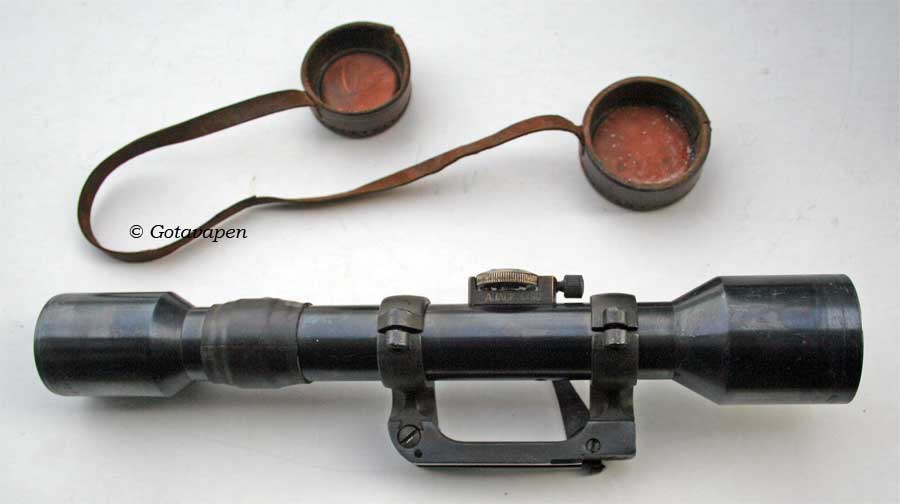
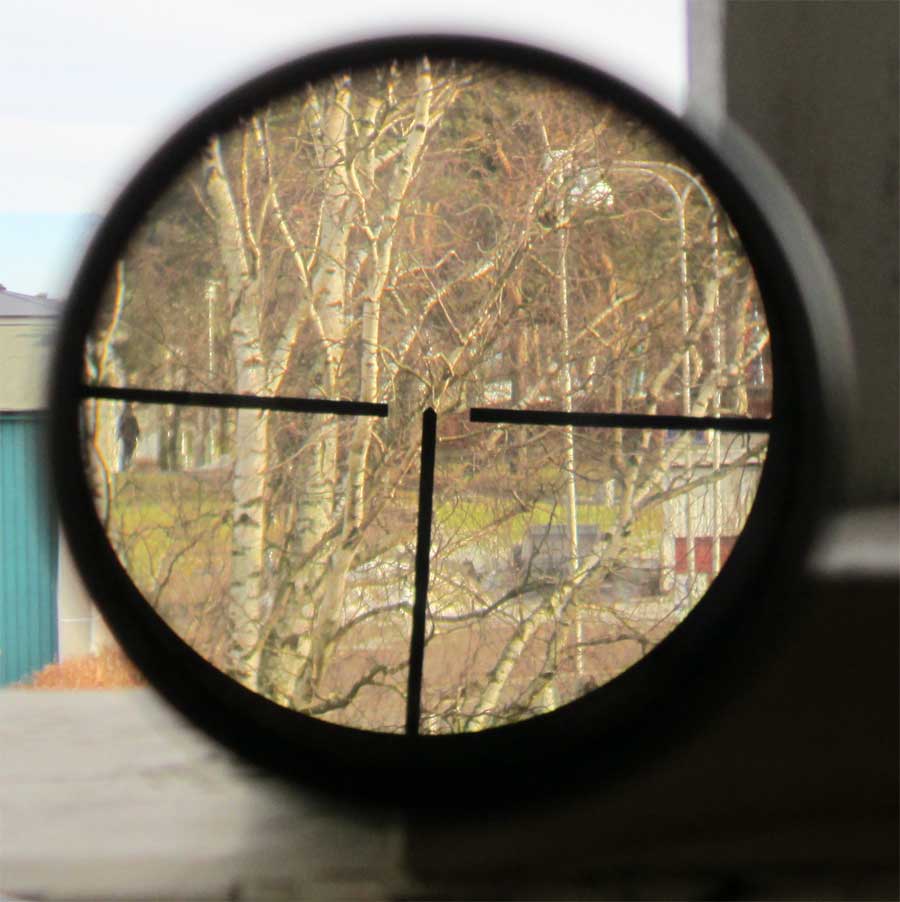
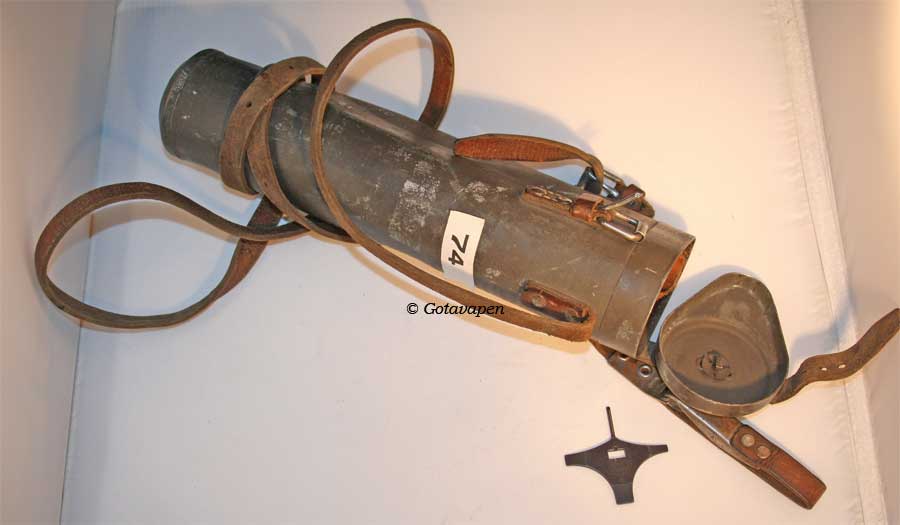
German made AJACK rifle
scope. |
[Top of the
page]
|
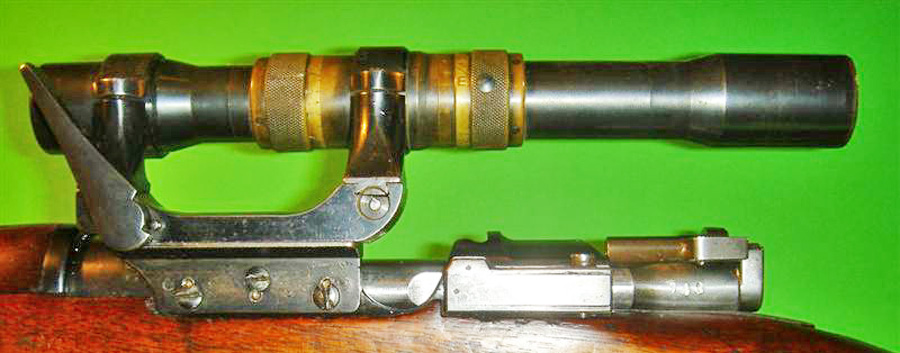
Swedish made Aga Rifle
Scope 42 |
 |
|
Swedish made Aga Rifle Scope m/42
used for Swedish Sniper rifle m/41. |
|
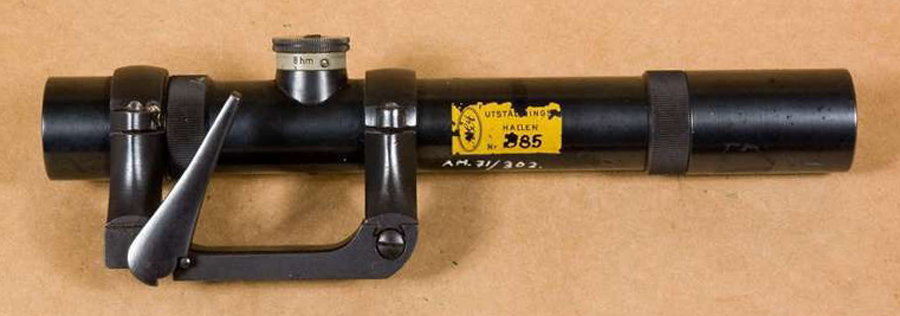
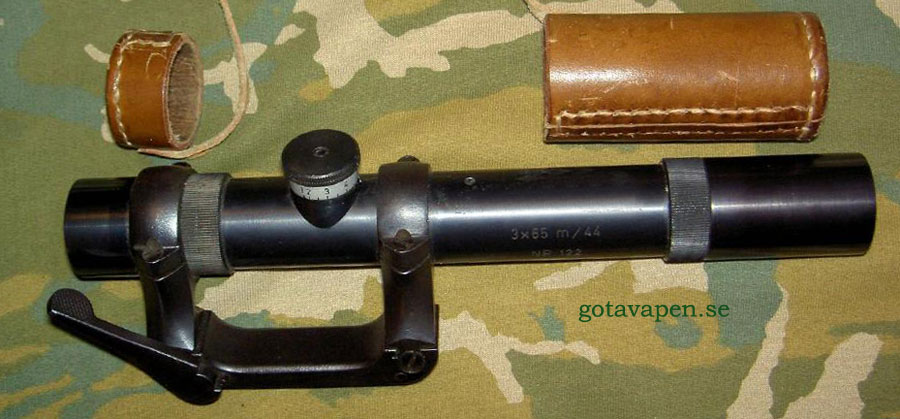
Swedish made Aga Rifle
Scope m/44 |
 |
 |
|
Swedish made Aga Rifle Scope m/44 scope
used for Swedish Sniper rifle m/41. |
The main differences between the m/41 and m/41 B rifles were:
Gevär m/41 Gevär m/41 B
Bolt: Metal finish. Blue (or brown).
Open sight:
Same as m/96 SM sikte m/55 (ramp sight). (with a knob to adjust elevation) or SM sikte m/58 (with a knob to adjust elevation, and two screws to adjust windage).
Scope:
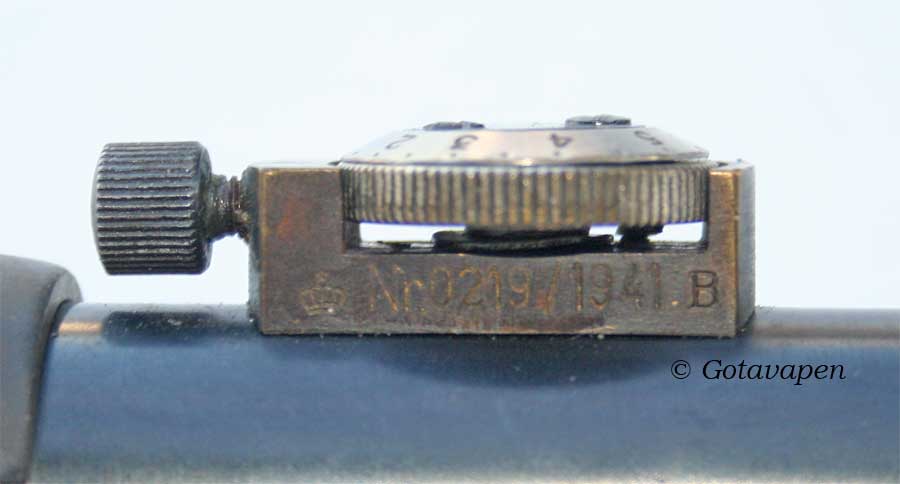
m/41 Ajack 4x90 m/41 B , an improved m/41 or m/42 AGA 3x65 (a "B" stamped on the left or
m/44 Nife 3x side, behind "1941").
Scope mount:
Not tempered, with Tempered, and with an a number of its own, adjusting bolt for the matching numbers on position of the scope, both parts. same number as the rifle on both parts.
Sling:
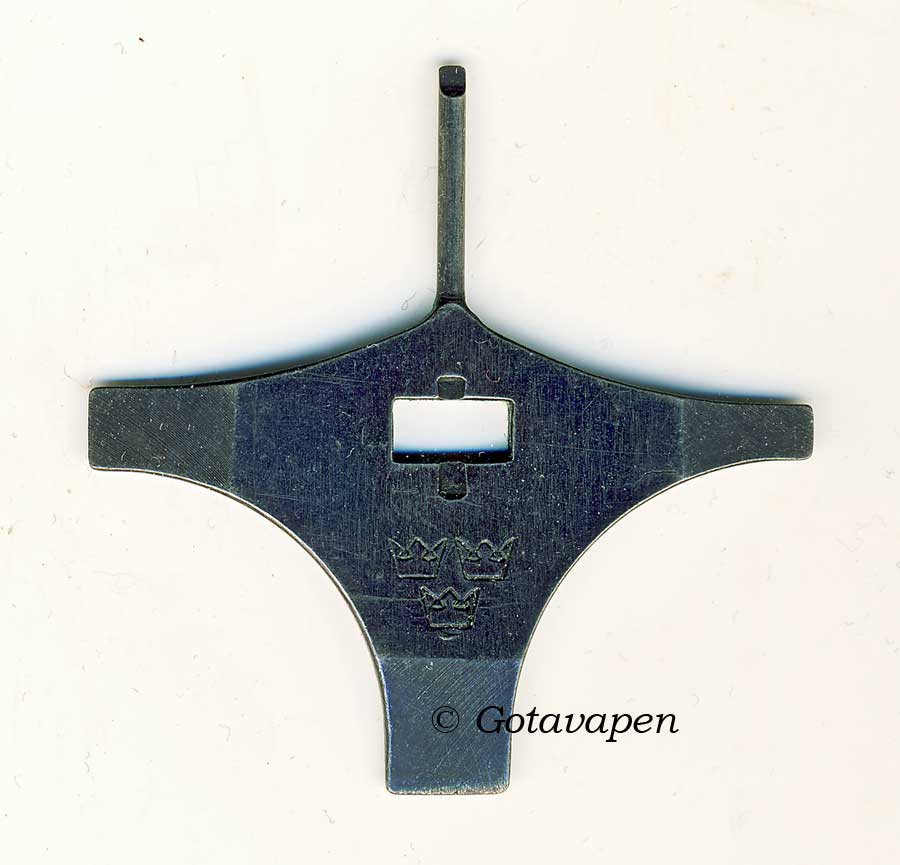
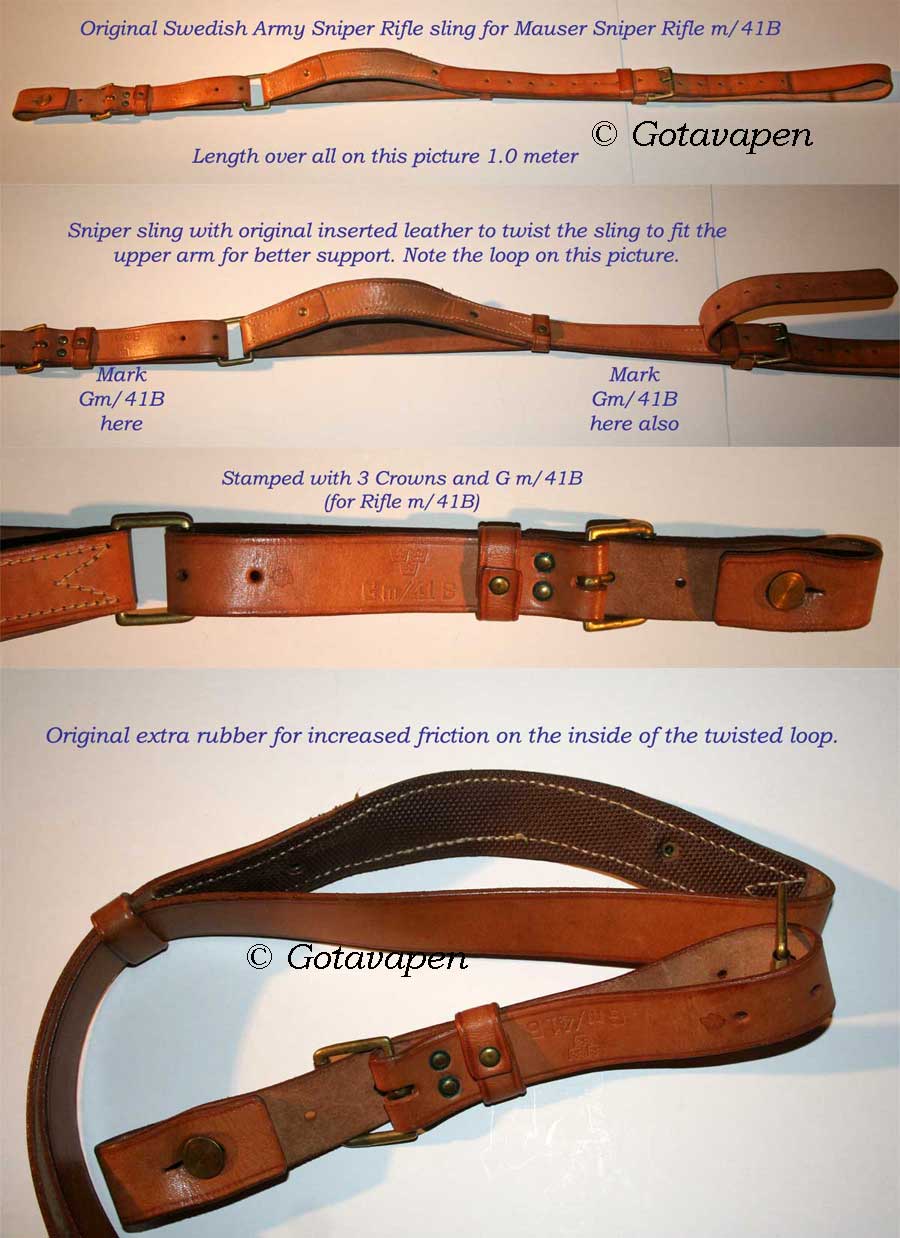
Sling with loop, marked with the three crowns and the text "G m/41 B".
See pictures.
Ref;
SoldI Mtrl 1963.
The m/41 (B) was made out of m/96 rifles that were picked for
there accuracy.
About 5300 were made between 1941 and 1943.
Since some m/41 (B) have the turned down bolt handle of the m/94 carbine
- it could be that these weapons were made from scratch - or maybe they
just got new bolts.
It seems like the m/41 B was made both by modifying m/41 rifles
and by making them directly out of m/96 rifles. Because on
some m/41 B one can see, that the part of the scope mount with
the adjustment bolt, have been welded on to the part with the
dovetail.
The m/41 B is, by far, the most common today.
The m/41 (B) is no longer in service, the last units to use
this (excellent) weapon were "Hemvärnet" ("the Home Guard").
During 1995 the Home Guard had to return their m/41 (B)
sniper's rifles, they were replaced by scoped Ak4 assault rifles
(H&K G3).
|
Here is a sling for
the Swedish Sniper rifle m/41B
[Top of the
page]
Rifle m/1938 (G m/38)
|
 |
|
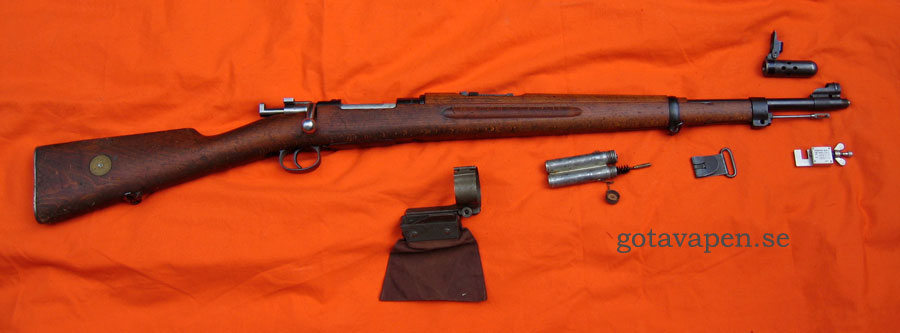
Rifle G m/1938 with accessories.
(Husqvarna)
Rifle m/38 used the same bayonet
like Rifle m/96. |
| Gevär
m/38, G m/38 |
| Type |
I |
II |
| Calibre |
6,5×55 |
| Ammunition |
6,5 mm m/94 |
| Feed |
5-round integral, double row magazine
|
| Design |
Mauser, model 1893 |
| Action |
Bolt action |
| Manufacturer |
Mauser |
HVA |
| GF |
| Year of delivery |
1939-1943 |
1942-1944 |
| Quantity |
≈30000 |
≈88000 |
| Barrel |
600 mm |
| Length |
1120 mm |
| Weight |
3,8 kg |
| Sights |
250-600 m (SM) |
100-600 m
150-600 m (T) |
| Miscellaneous |
Similar to G
m/96 but with shorter barrel. |
| Same action as G
m/96(straight bolt handle), actually these are converted G m/96's |
Same action as K
m/94 (turned down bolt handle), or as G
m/96 (straight bolt handle) |
| Gevär m/38 B; with threaded muzzle to accept a blank
firing adapter |
| Status |
Obsolete - except a few used for training
(1999) |
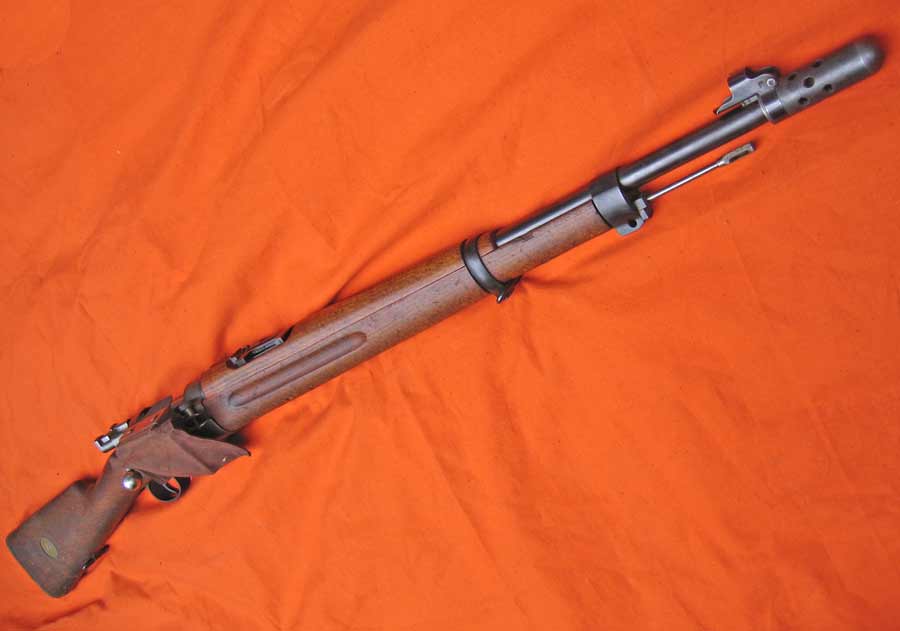
Rifle m/38 Prepared for peace time training with
brass catcher and blank firing device.
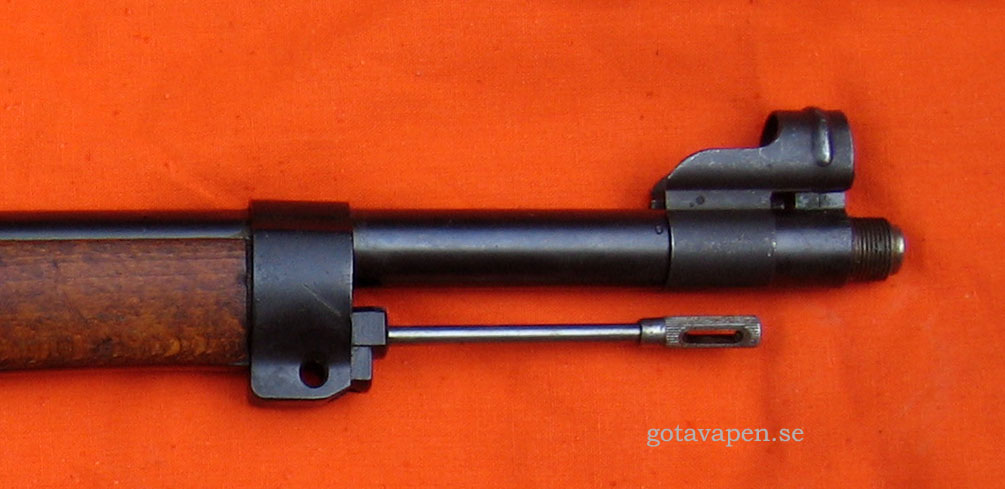
Front sight protection
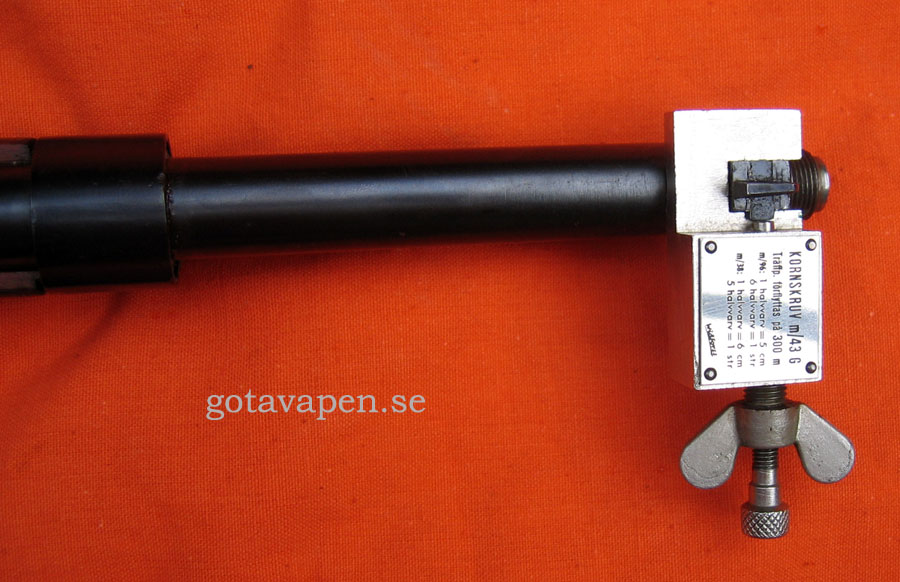
Adjustment tool for front sight m/43G
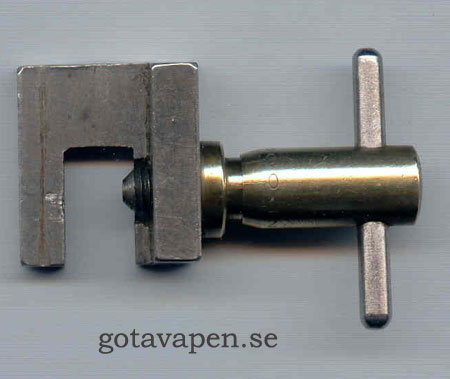 |
Old type of adjustment tool
for front sight |
|
| There are two types of the m/38 rifle:
Type one (1) m/38 rifles are made from old m/96 rifles
These are manufactured by Carl Gustaf or by Mauser.
They have the same straight bolt handle as the m/96 rifle.
They have the same rear sight as the m/96 rifle, but with
an inserted nickel-plated SM micrometer sight m/38.
*The m/38 SM sight goes from 250 to 600 metres, the elevation
knob is stamped with "3", "4", "5" and "6".
The sight is calibrated for the m/94 ogival (blunt) ammunition.
Type two (2) m/38 rifles are made as m/38 rifles
These are manufactured by Husqvarna
They could have either the same straight bolt handle as
the m/96 rifle, or the turned down bolt handle of
the m/94 carbine.
They both have leaf sights, either for the m/94 ogival (blunt)
bullet, or for the m/41 torped (pointed) bullet.
*The sight for the m/94 cartridge can be adjusted, in 50m
steps, from 100 to 600 metres.
This sight got a rectangular notch.
*The sight for the m/41 cartridge can be adjusted, in 50m
steps, from 150 to 600 metres. The ladder is stamped "2",
"3", "4", "5" and "6".
This sight is marked with a "T", it got a U-shaped notch.
Type 1 m/38 rifles are sometimes referred to as "m/96-38", but there were
never an official denotation for this type. The Swedish Army never bothered
about the difference between the type 1 and type 2 m/38 rifles.
In the Army's spare part list for the m/38 rifle there is a note that one could
use a spare bolt for the m/96 rifle just as well.
The reason why some type II m/38 rifles have straight bolt handles is not
absolutely clear to me.
But it seams that when WW2 begun there were a stock of bolts for the m/96 rifle,
and these were used for some of the m/38 rifles.
The m/38 used a different front sight than the m/96 rifle.
The m/38 front sight post for the m/38 rifle is 1,7 mm wide at the top, while
the m/41 front sight post for the m/96 and m/41 rifles is 2,2 mm wide at the
top. The m/38 front sight is one and a half millimetre higher than the m/41
front sight. Beside the height and the width of the post, the m/38 and m/41
front sights are interchangeable. A ±0 m/38 post corresponds to a +1,5 m/41
post.
The m/38 front sights are available in 12 different heights, from -2 to +0,75
millimetres in 0,25 millimetre increments.
The m/38 rifle should be sighted in to strike one mil above the aiming point.
If it is sighted in for the pointed m/41 "torped" bullet, there should be a "T"
stamped on the right side of the base of the front sight.
The 1938 rifle used the same m/96 bayonet
as the original Mauser rifle from 1896.
I don't know if the m/38 rifle was ever used by the Cavalry - at least it was
never intended to be used by mounted troops (if it was, it would surely have
used the same kind of sling as the m/94 carbine).
It's my impression that the m/38 was only used by truck-drivers, light infantery
(jägare) and the few mechanized units of the infantry and the cavalry, and by
the Navy.
|
[Top of the
page]
Rifle m/1939
& m/1940
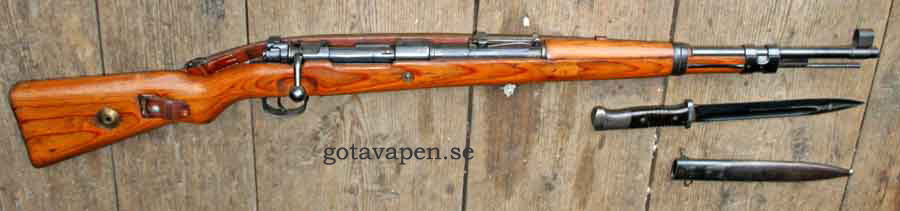 |
|
Original Swedish rifle m/39 with bayonet delivered by CG |
| Gevär m/39, G m/39 |
| Calibre |
8×57 IS |
| Ammunition |
8 mm m/39 |
| Feed |
5-round integral, double row magazine |
| Design |
Mauser model 1898 |
| Action |
Bolt action |
| Manufacturer |
Mauser |
| Year of delivery |
1939 |
| Quantity |
5000 |
| Barrel |
600 mm |
| Length |
1110 mm |
| Weight |
4,2 kg |
| Sights |
100-600 m |
| Miscellaneous |
German Kar 98k |
| Status |
Modified to G
m/40 |
|
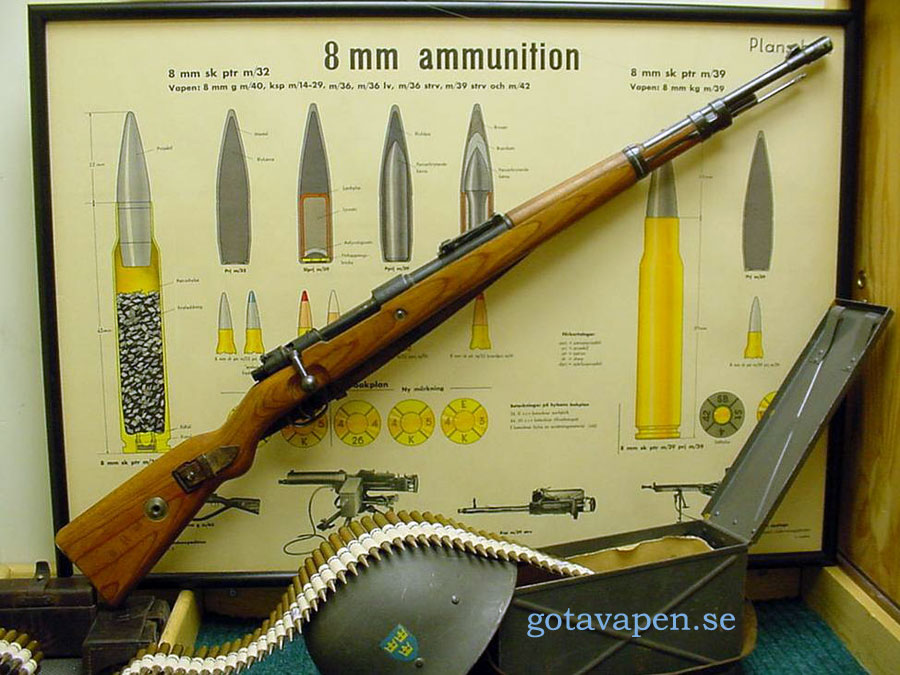 |
|
Swedish rifle m/40
Read more about the rifles m/39 & m/40
here>>> |
| Gevär m/40, G m/40 |
| Calibre |
8×63 |
| Ammunition |
8 mm m/32 |
| Feed |
4-round integral, double row magazine |
| Design |
Mauser model 1898 |
| Action |
Bolt action |
| Manufacturer |
Mauser |
| Year of delivery |
1942-43 |
| Quantity |
4900 |
| Barrel |
600 mm |
| Length |
1135 mm |
| Weight |
4,25 kg |
| Sights |
100-600 m |
| Miscellaneous |
Modified G
m/39 |
| Status |
Obsolete, sold |
|
Production
of Swedish Army Rifles
m/1896, m/1938, m/1941 and Carbine m/1894.
| Weapon |
Manufacturer |
Production |
Quantity |
|
Carbine m/94 ("Karbin
m/94") |
Mauser |
1894-1896 |
12.000 |
|
Carbine m/94 ("Karbin
m/94") |
Carl Gustafs Stads
Gevärsfaktori |
1895-1933 |
115.000 |
|
Rifle m/96 ("Gevär m/96") |
Mauser |
1896-1899 |
40.000 |
|
Rifle m/96 ("Gevär m/96") |
Carl Gustafs Stads
Gevärsfaktori |
1899-1936 |
475.000 |
|
Rifle m/96 ("Gevär m/96") |
Husqvarna Vapenfabriks AB
(HVA) |
1942-1944 |
20.000 |
|
Rifle m/38 ("Gevär m/38") |
Carl Gustafs Stads
Gevärsfaktori |
1938-1940 |
55.080
m/96 were converted to m/38 |
|
Rifle m/38 ("Gevär m/38") |
Husqvarna Vapenfabriks AB
(HVA) |
1942-1944 |
88.150 |
|
Sniper rifle m/41 ("Gevär
m/41") |
Carl Gustafs Stads
Gevärsfaktori |
1941-1943 |
5.300
selected and modified m/96 |
[Top of the
page]
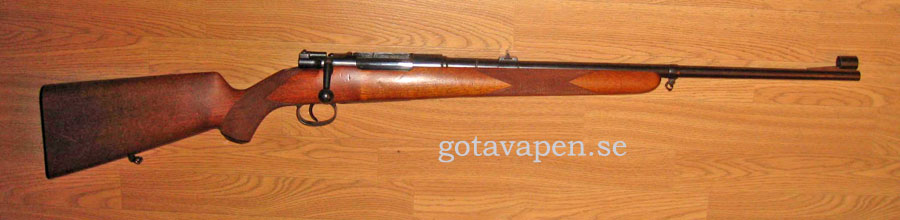
The
Swedish Partisan Rifle
|
During
WW2 Husqvarna Vapenfabrik produced rifles which were intended to be used by
a resistance movement in Sweden in case of occupation by the Nazis. This is
not a Military rifle. The
mechanism used was the old standard Mauser m/96 mechanism similar to
fm/23-36 and the calibre
was 7.9x58JS mm like the standard German Military ammunition. The m/96
mechanism is considered to be weak for the heavy German cartridge, because
of only 2 locking lugs.
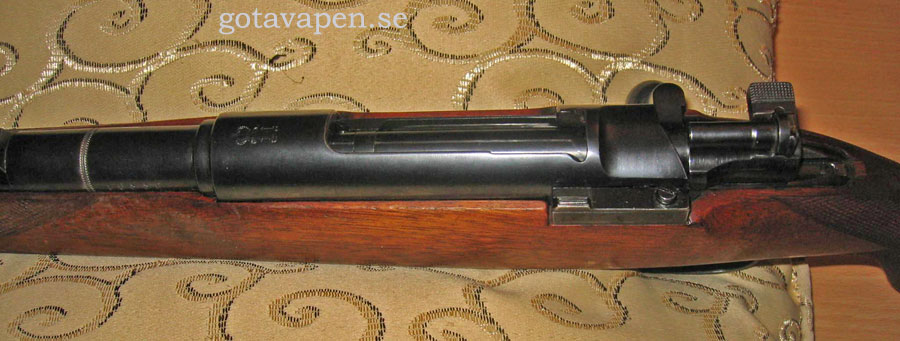
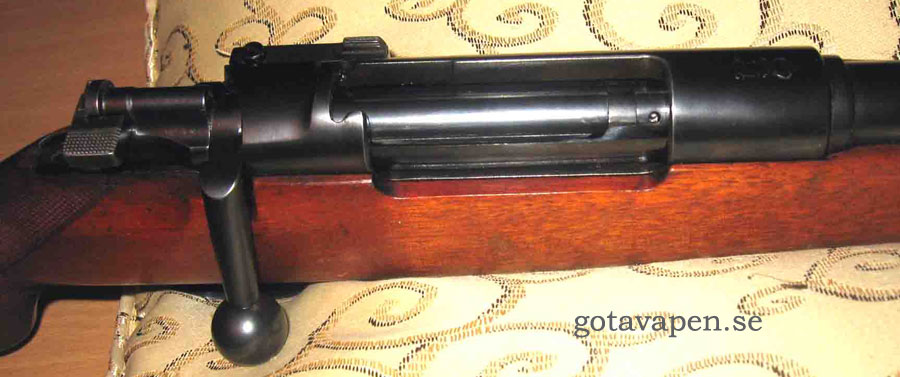
In
order to strengthen and improve the receiver, it was produced without any
groove for the thumb. |
 |
 |
|
The
stronger HVA m/96 receiver.
Note
the wall of the receiver has no grove for the thumb |
|
 |
[Top of the
page]
Semiautomatic Rifle m/1942
and improved m/42B

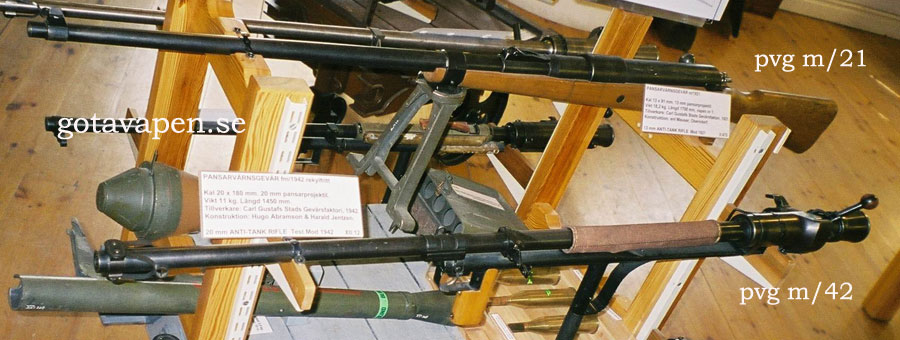
Swedish Anti Tank Rifles
[Top of the
page]
Swedish Anti Tank Rifles
FAQ about Swedish
Mausers.
References:
|
Sven Nyberg |
|
Mats Persson |
|
Karl-Olof
Björsell |
|
Rolf
Björklund |
|
Members of Gothia
Arms Historical Society |
|
Soldier Instruction
manuals 1939-1943 |
|
Lt Colonel Axel
Ekfeldt |
|
Vapenmuseet |
|
Lt Colonel Stellan
Bojerud |
|
Krigsarkivet |
|
Anders Arvidsson,
Swedish Homeguard |
|
Ulving, S.
Arvidsson, P. ;Ett skott en träff. |
|
Hunts, Stockholm |
|
FMV
|
|