|
The
Swedish machineguns before 1950.
Text and pictures by O. Janson
updated
2020-04-30
|
This
series of articles will basically only deal with Swedish Army Machine guns
used as support weapon which can be carried by the soldiers and used
separated from vehicles.
Sweden
has a long history of Machine guns. 1865 Sweden tested Richard Gatling’s
machine gun from 1862. It had the designation Kulspruta fm/1865 (Machine gun
test model / 1865). The calibre was 11 mm and had 10 barrels which turned
around by cranking a handle. It never became adopted. The Gatling is a
mechanical operated machine gun and not automatic.
In 1870
Lt. D. H. Friberg got a patent for his operating principles of a real
automatic machine gun! The earliest drawing found are dated 1882! This was
before Maxim made his machine gun. Due to the black powder ammunition which
was used at that time, the gun became full with slag very fast and
malfunctioned. Because of this reason nothing came out of Friberg’s
invention that time.
|
Look at Nordenfelt's
2 barrel
Mechanical Machine gun here
on
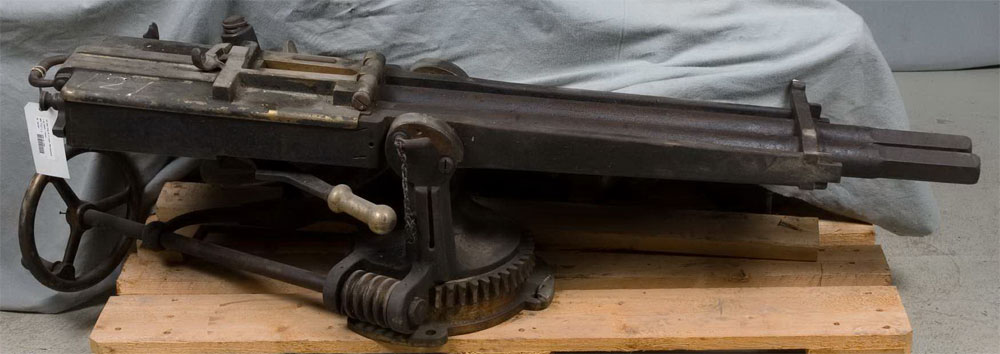
(picture
Armémuseum)
|
Early test with revolving barrels 1869.
This Machine
Gun with 10 revolving barrels was designed 1869 by Helge Palmcrantz
(1842-1880). Test showed that the mechanism was unreliable if more than 300
shots per minute were fired.
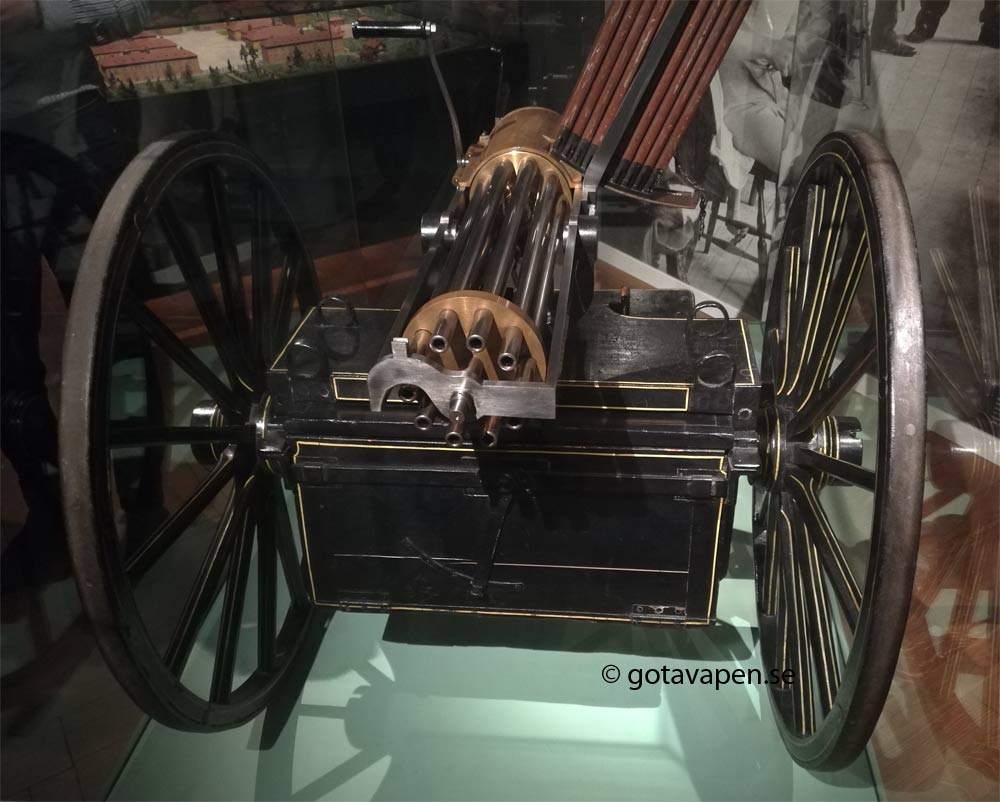
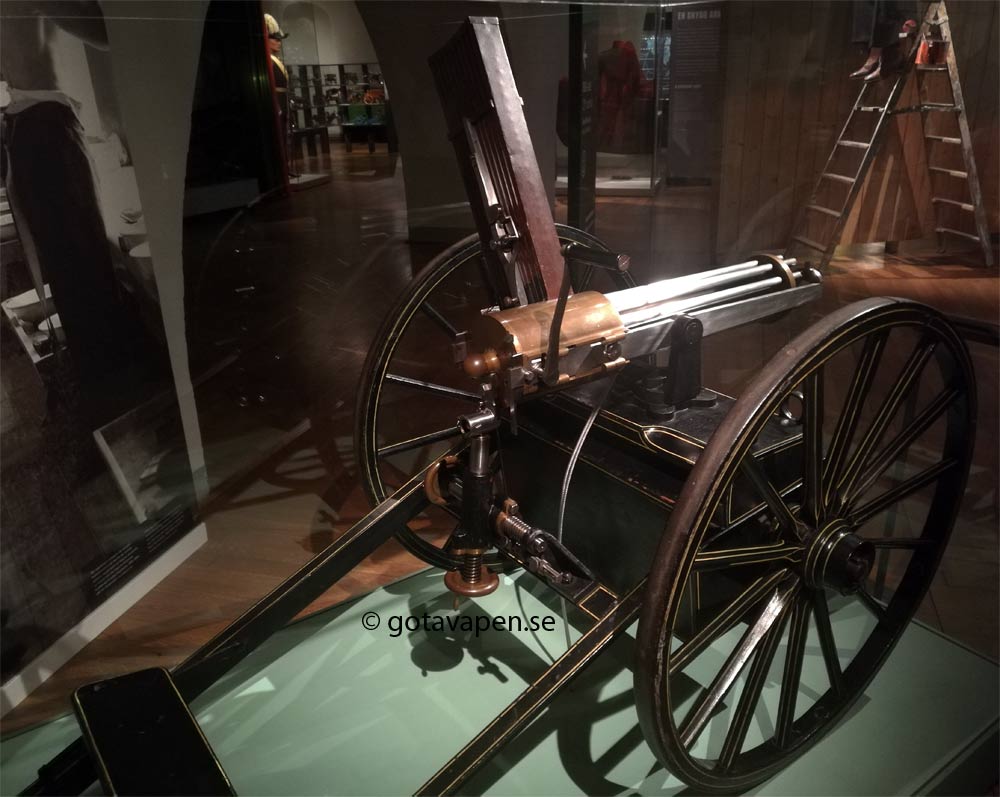
In 1874 he patented a new construction with
horizontal barrels, which became a success throughout Europe. The main
problem was the black powder cartridges.
Kulspruta m/1874
The
first adopted
Mechanical Machine gun was Kulspruta M/1874 (Kulsp M/74).
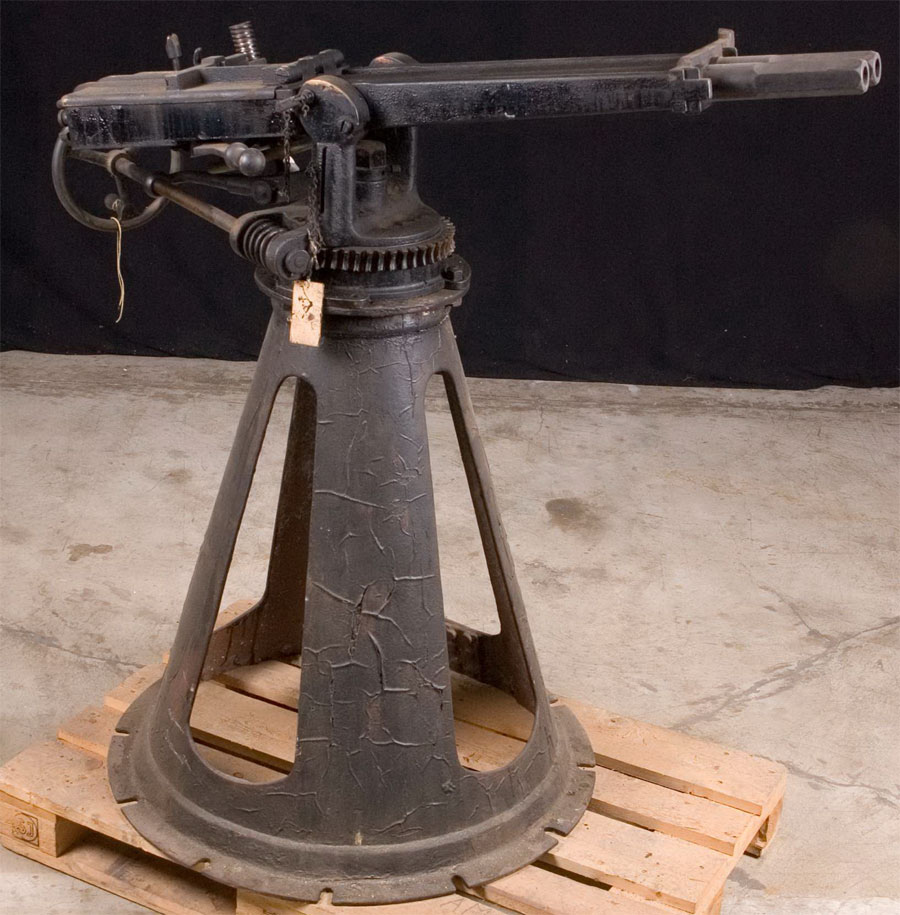
Machinegun
M/1874 (25mm)
(picture Armémuseum)
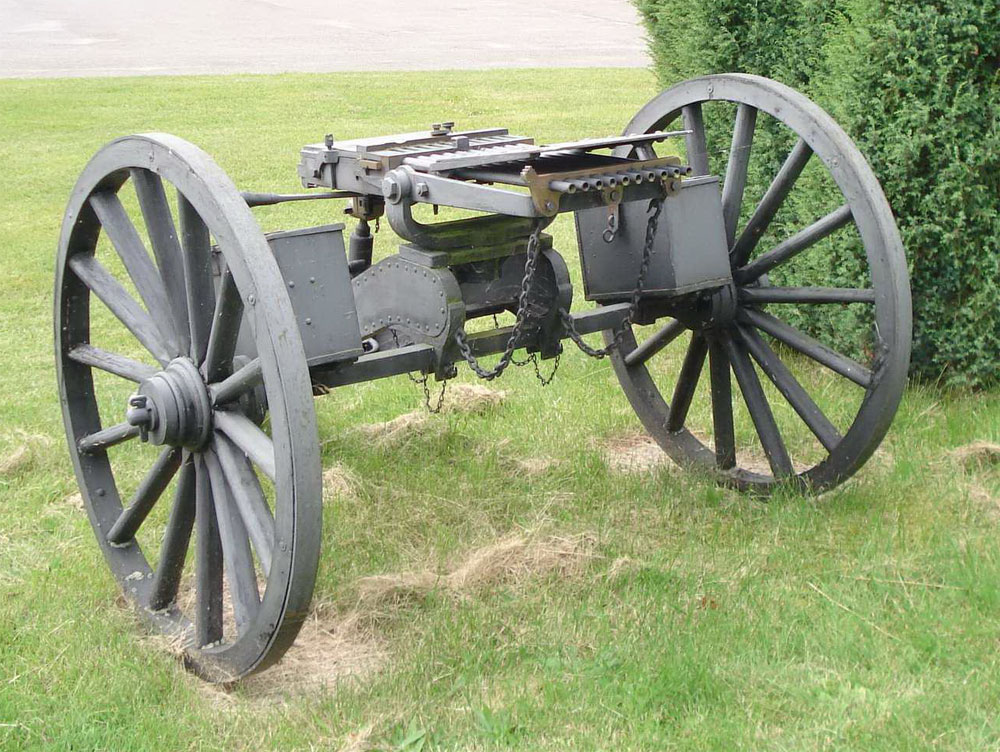
Kulspruta m/1875 (Kulsp m/75)
The
second adopted
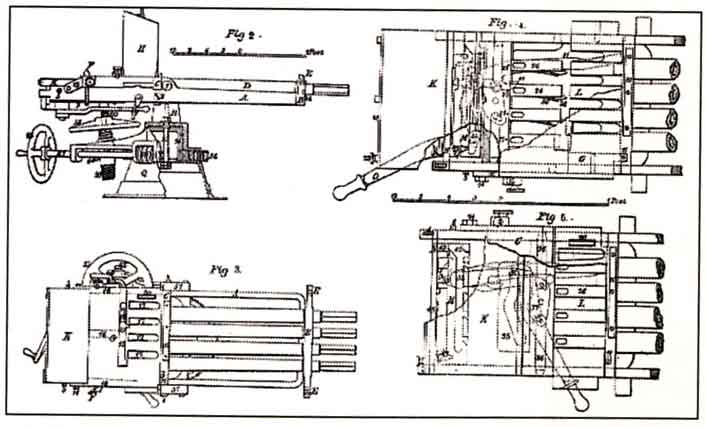
Mechanical Machine gun was Kulspruta m/1875 (Kulsp m/75). It was also a
multi-barrel construction. It was made by Stockholms Vapenfabrik. The
calibre was the same as the Swedish Remington rifles – 12,17x42R. |
|
Specifications: |
|
Kulspruta m/75, Kulsp m/75 |
| Calibre |
12,17×42R |
| Ammunition |
12,17 mm Swedish m/67 |
| Feed |
Gravity fed hopper, 100 rounds |
| Rate of fire |
500 shots/min |
| Muzzle velocity |
380 m/s |
| Maximum range |
900 m |
| Design |
Helge Palmcrantz |
| Action |
Lever-actuated |
| Manufacturer |
Stockholms Vapenfabrik |
| Barrel |
950 mm |
| Length |
1120 mm |
| Weight |
115 kg, 171 kg including carriage |
| Miscellaneous |
10 barrels |

|
Machinegun
Kulspruta m/1900
(Klsp m/1900)
or Hotchkiss Mle'95.
|
|
1910 Sweden accepted
the Hotchkiss Mle’95 machine gun
as Kulspruta m/1900. (Klsp m/1900)
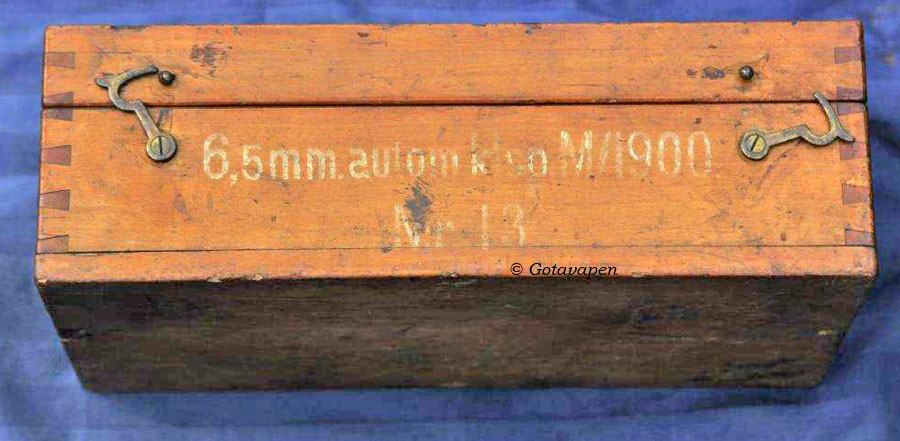
Marked
automatisk klsp M/1900
Automatic mchinegun M/1900
The
gas-operated Hotchkiss MG are named after the company and not after the
designer. Benjamin Hotchkiss was famous for his mechanical multi-barrelled
machine gun constructions similar to the Gatling system. He died 1885 before
the invention of gas-operated machine gun. Maxim’s patents on
recoil-operated machine gun systems caused the Hotchkiss company great
problems to design their own machine guns and they were on the brink to go
bankrupt. An Austrian Army Captain, Baron Adolf von Odkolek, had made a
design with gas-operation for machine gun, which he offered to Hotchkiss
company. An American called Benét refined the system and made the famous
Hotchkiss Mle’95 machine gun. This was the first successful gas-operated
automatic machine gun. The French machine gun M1914 is only a slight
variation of this MG. |
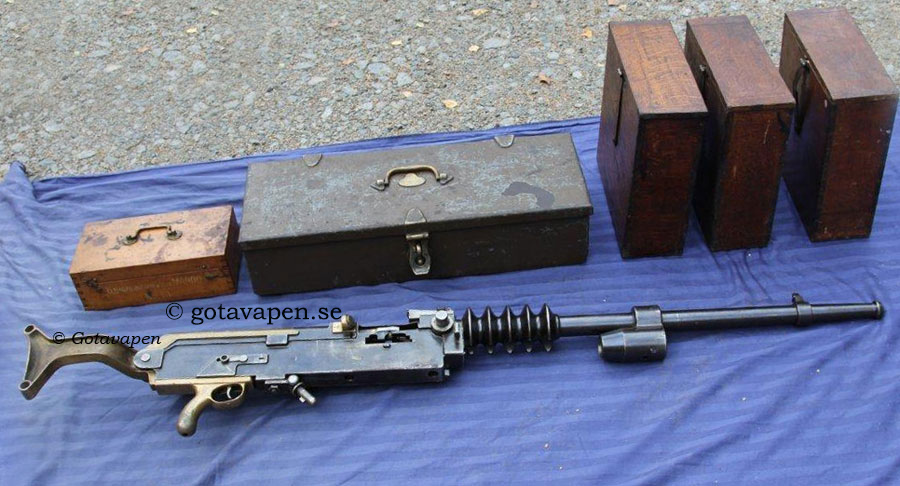
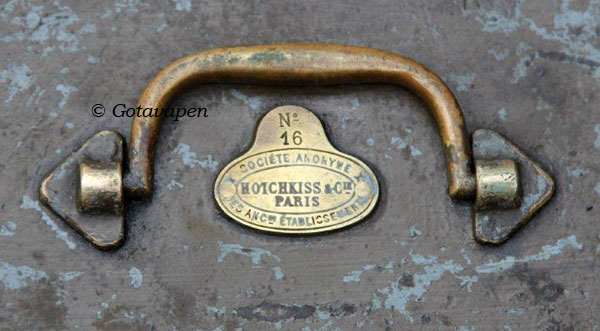
Lid
marked Hotchkiss Paris
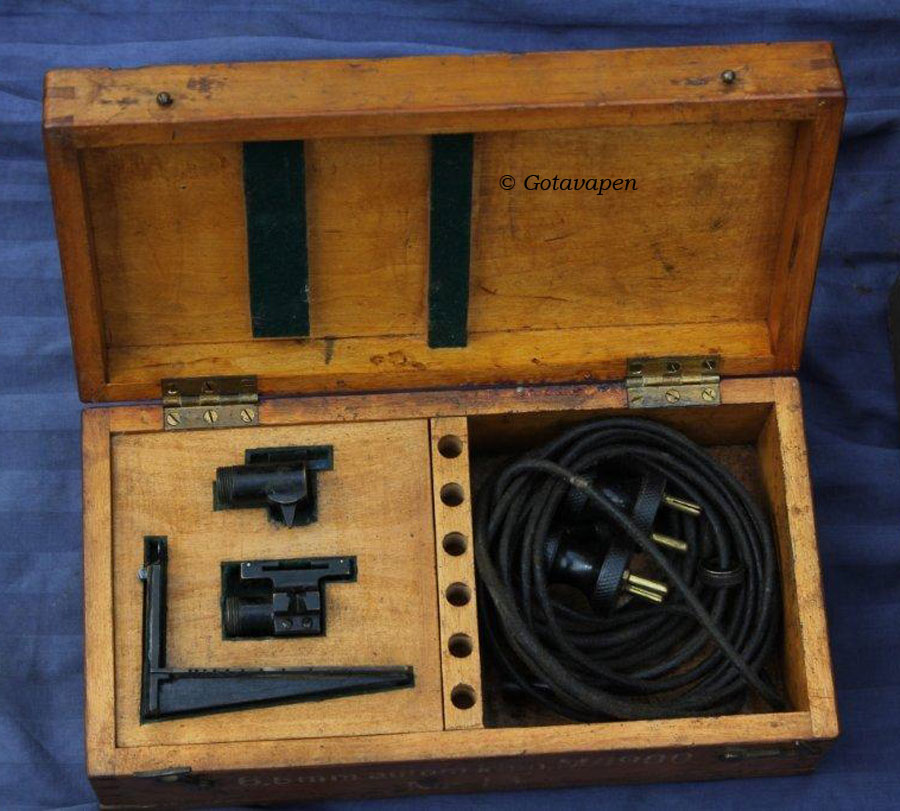
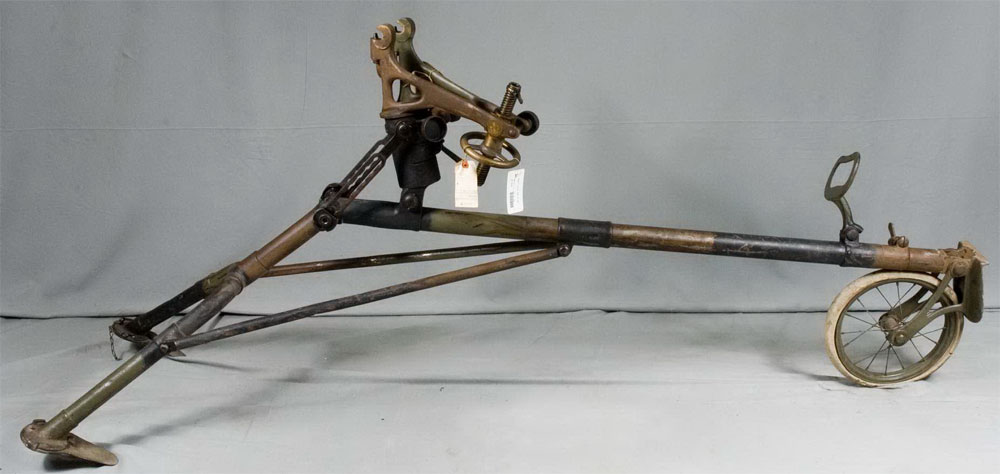
Picture above by Armémuseum
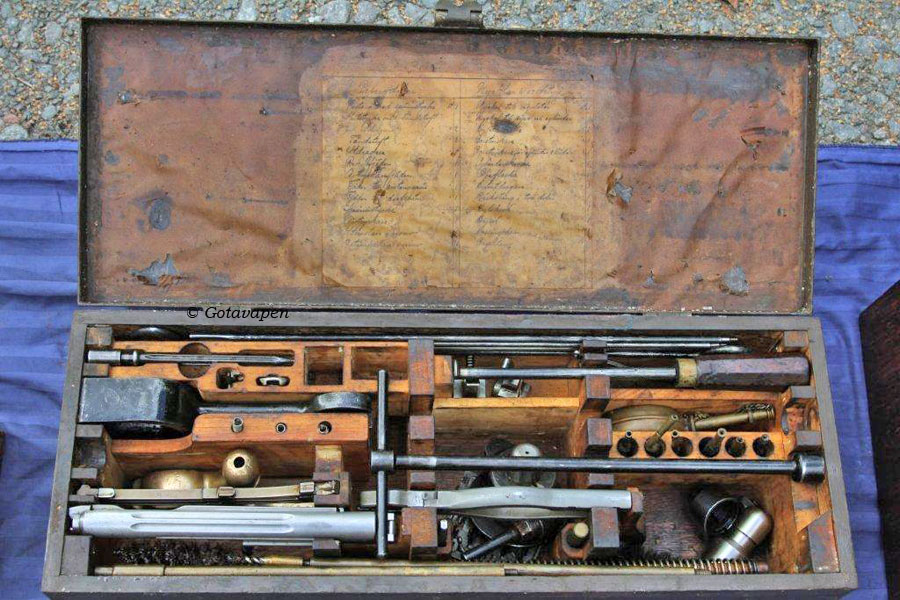
Case for machinegun
|
Specifications: |
| Kulspruta m/1900, Kulsp
m/1900 - Hotchkiss Mle'95 |
| Calibre |
6,5×55 |
| Ammunition |
6,5 mm m/94 |
| Muzzle velocity |
730 m/s |
| Maximum range |
1660 m |
| Feed |
30-round strips or 200-round belts |
| Rate of fire |
8 - 10 /s 480-600 /minute |
| Design |
Baron Adolf Odkolek von Augezd |
| Hotchkiss Mle'95 |
| Action |
Gas operated |
| Manufacturer |
Hotchkiss |
| Quantity |
30
pieces |
| Barrel |
758 mm, 4 grooves |
| Length |
1425 mm |
| Weight |
23 kg |
| Sights |
Tanget sight 250-2000 m |
| Miscellaneous |
Aircooled |
| Two versions, first one same as French Mle'97
|
| Status |
Obsolete, sold in 1940 |
|
Kulspruta m/1914
or Schwarzlose Machine Gun M1907/12.
|
|
1914 Sweden accepted the the
Medium Machine Gun (MMG) Schwarzlose M 07/12
as Kulspruta m/1914. (Ksp m/14)
|
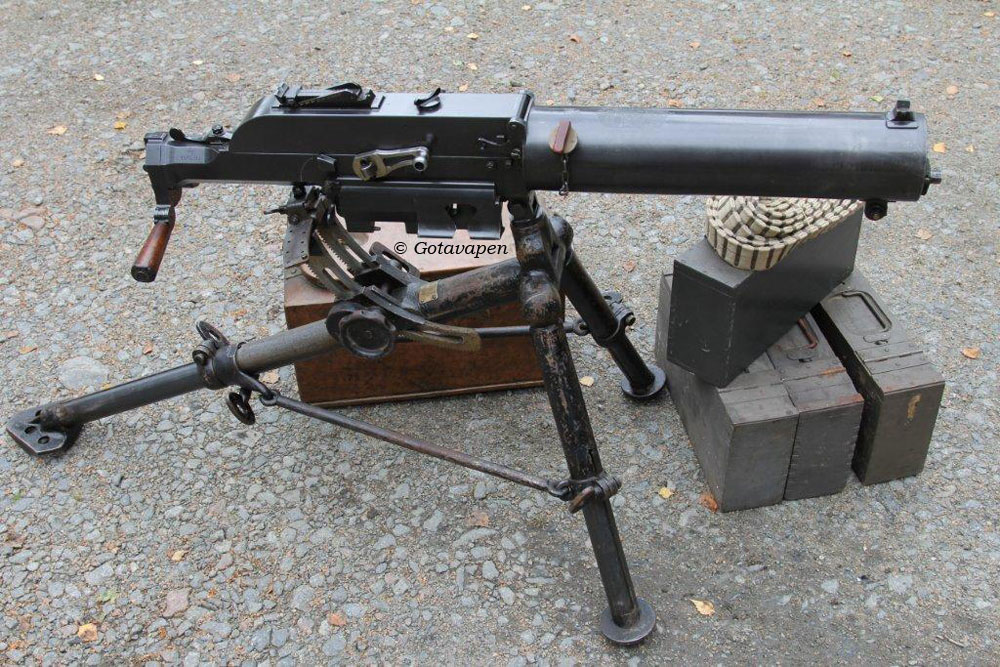
(private collection)
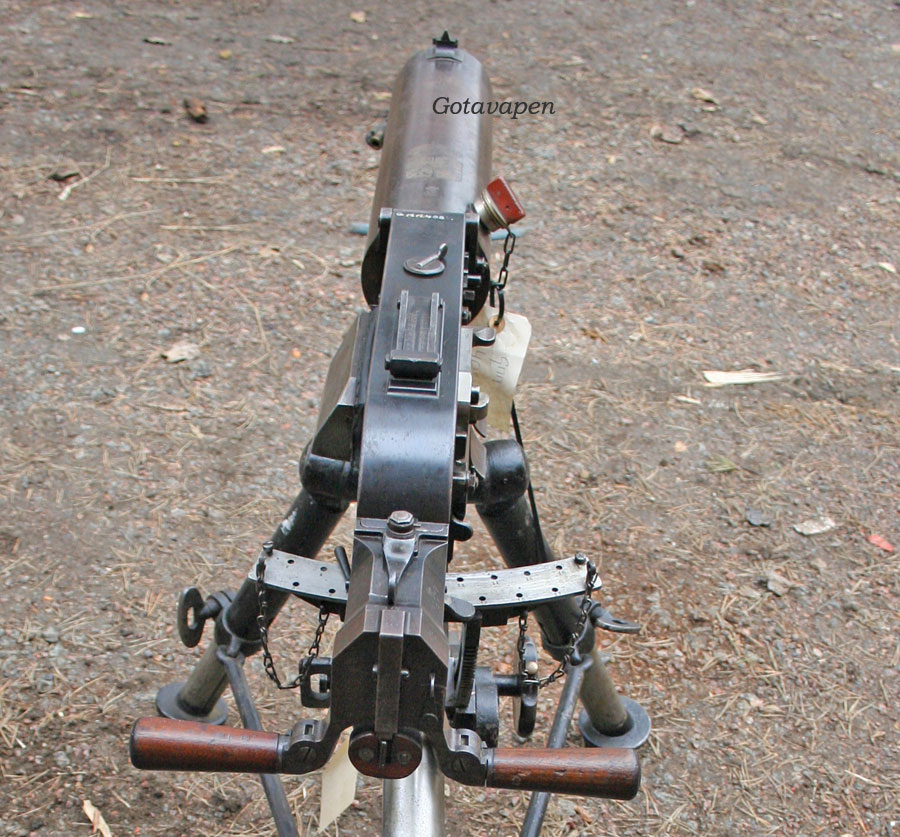
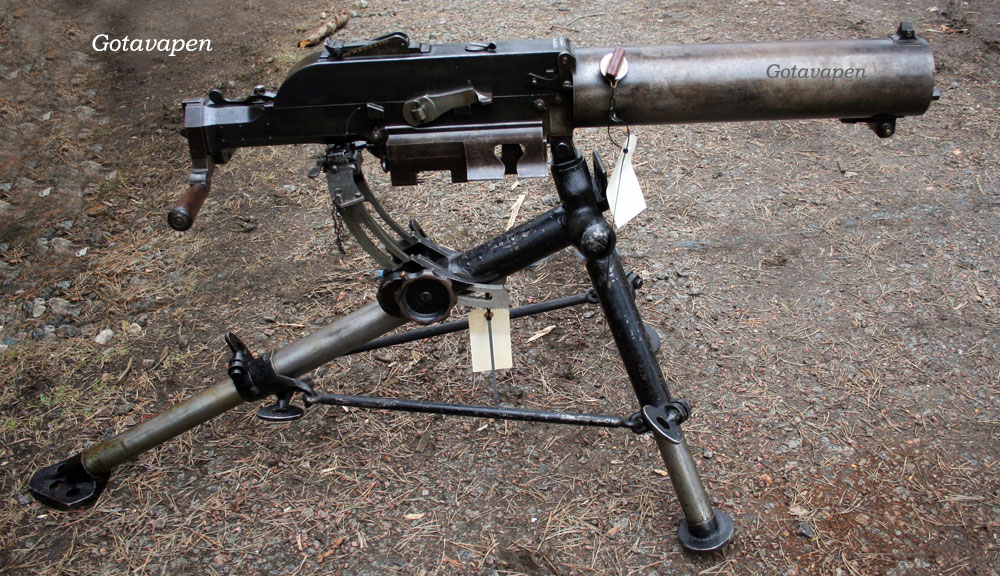
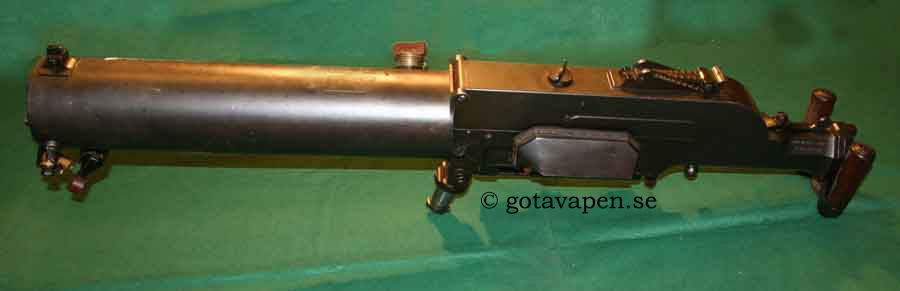
Swedish Medium
Machine
Gun m/1914 (Schwarzlose)
(private collection)
|
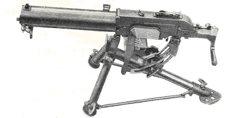
This Machine Gun became very
successful and still until today the Ksp m/1914 remains on the Machine Gun
medals of the Swedish army.
|
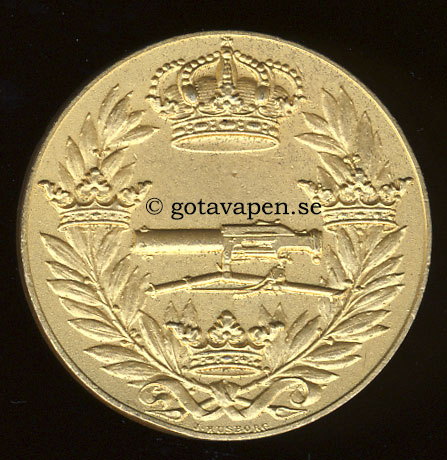
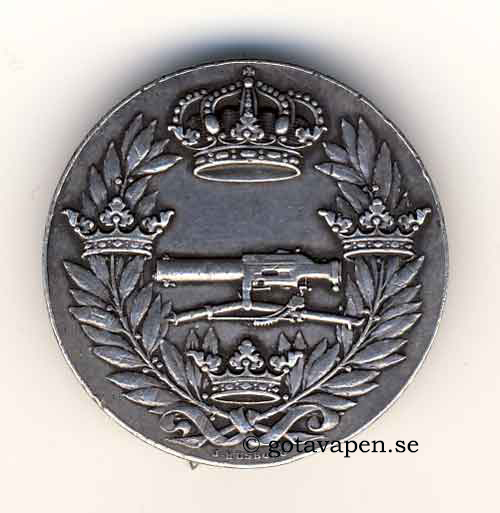 |
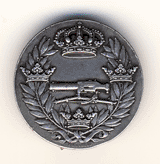
Swedish
army machine gun marksmanship
badge made out of sterling silver. The gun is
a Schwarzlose M07/12 water cooled machine gun surrounded by the three
Swedish crowns, which are a National symbol for the country and on top the
royal crown. Note all the details!
When the author
made his army service you could choose to shoot with either the MMG
water-cooled Browning Ksp m/36 or the FN MAG ksp 58. It was much easier to
win the medal by using Ksp m/36. |
|
|
 |
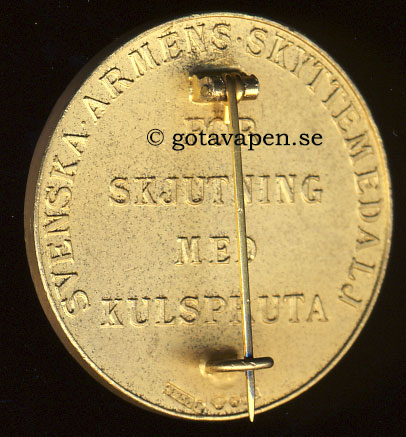 |
| Swedish
army machine gun badge for marksmanship
in Gold, made
out of Sterling Silver. |
With Three Crowns "Cat
foot" as a mark for the Sterling Silver. |
 |
| |
|
Swedish Medium
Machine
Gun m/1914 (Schwarzlose)
(private collection)
|
|
Background:
The machinegun
is unusual because it is the only successful military machine gun working on
the delayed blowback system before H&K systems at 1950.
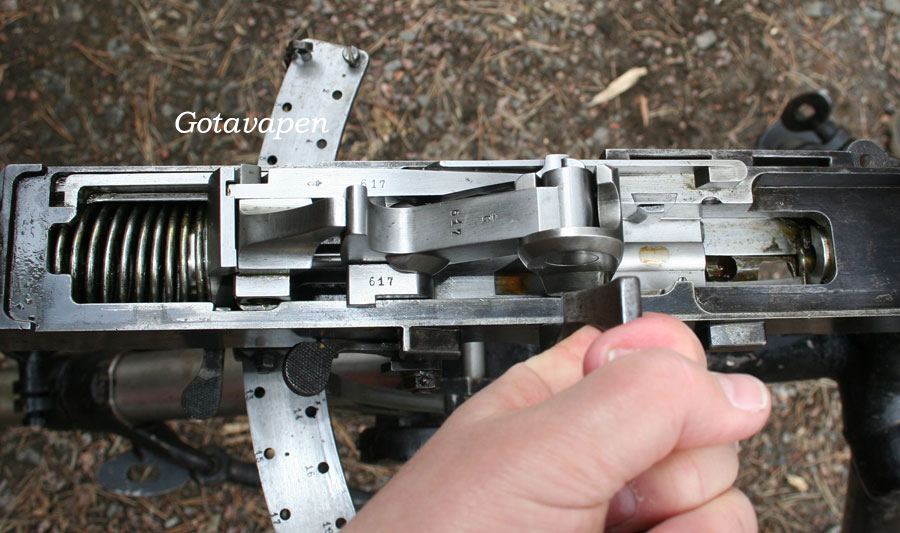
Mechanism (private collection)
The machine gun
has got its name after its constructor Andreas Wilhelm Schwarzlose
(1867-1936) who lived in Charlottenberg, Germany. It was first produced by
Steyer in Austria 1902.
The machine gun
has a small number of moving parts and a fixed barrel. It saw service during
both the Great War and WW2.
This is a water
cooled Medium Machine Gun (MMG).
The Schwarzlose
Machine Gun M1907 was an extremely simple mechanism compared to other famous
designs like Maxims. It was easy to make and proved reliable. The designer
had managed to solve the problem with a delayed blowback system. The problem
is that the breech starts moving backwards immediately as the cartridge is
fired. The gas pressure is still very high and the walls of the cartridge
case are expanded towards the chamber, which will cause very high friction.
At the same time the extractor starts pulling out the empty cartridge case.
The problem was solved by using very strong recoil springs and recoil parts
together with a very short barrel. When the bullet left the barrel the
pressure dropped while the kinetic energy of the recoil parts continued to
pull out the empty cartridge case and reload the gun. The Schwarzlose
machine gun has a device for oiling each cartridge to ease the reloading
cycle. On each stroke oil was squirted into the firing chamber to lubricate
the incoming cartridge case.
1912 some
changes were made to the feed system and this change was called M1907/12. It
had a straight top receiver and a simplified oil pad system instead of the
pump mechanism.
|
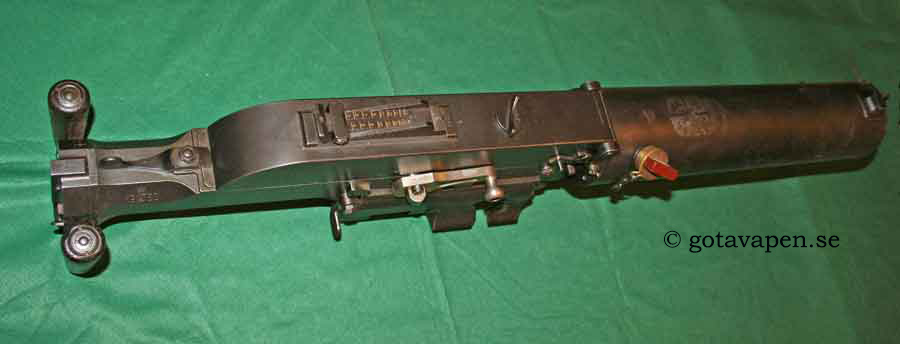
This m/14
above
was made 1930 by Carl Gustaf
Stads Gun Factory.
This
MMG m/14 was one of the last made Schwarzlose. The year of production (1930) can clearly be seen close to the handles.
|
Sweden:
The
Schwarzlose Machine Gun was made under license in Sweden
(and
Netherlands).
The construction proved to be a remarkably successful machine gun.
Carl
Gustafs Stadts Gevarsfaktori in Eskilstuna Sweden produced about 1 300
Schwarzlose machine guns. Browning designs replaced m/14. However the
Schwarzlose tripod m/14 remained until about 1980. |
 |
|
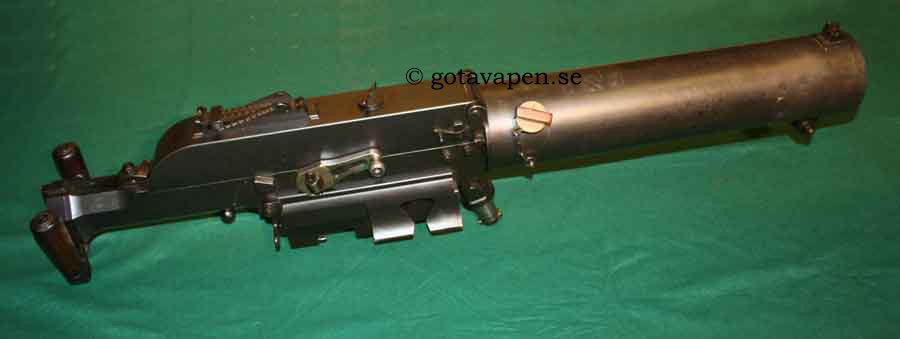
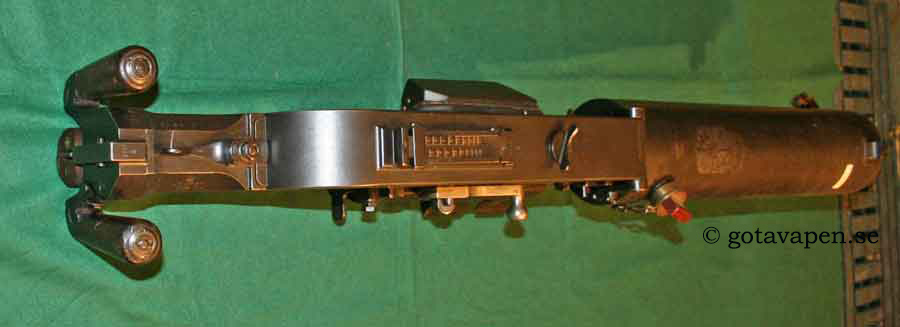
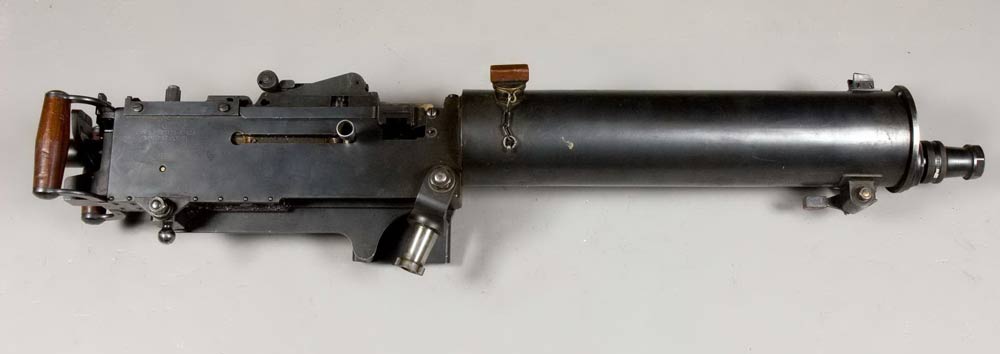
Top view of the Kulspruta
m/1914 |
 |
|
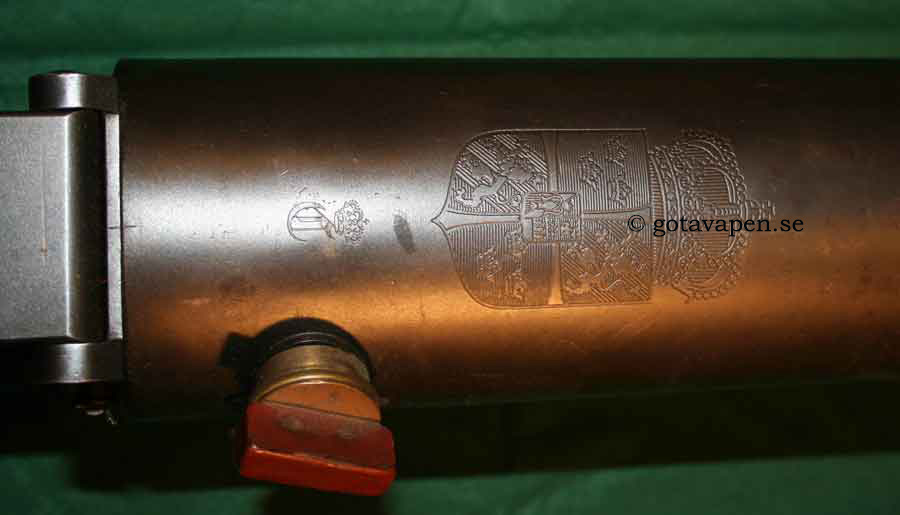
The
water cooling jacket was nicely decorated with the Swedish national coat of
arms
and a "C" topped of with the royal crown for Carl Gustaf gun factory.
|
[Top of the
page]
|
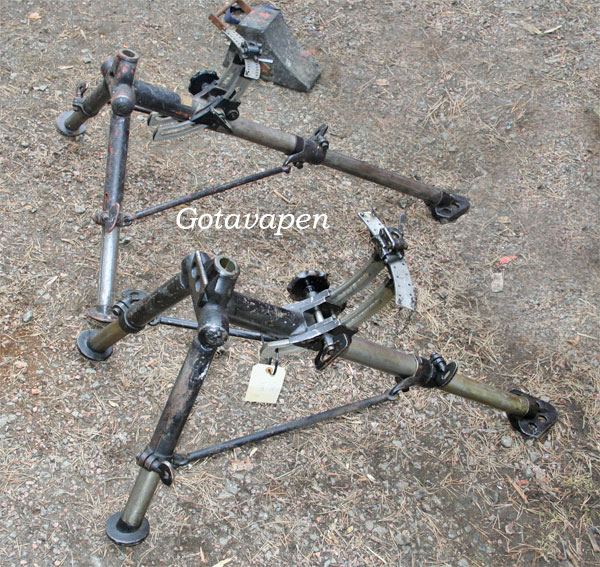
Tripod m/1914
The
Schwarzlose Machine Gun was put on top of a compact tripod with locking bars
to prevent the MG from collapsing. |
 |
The
elevation is controlled by a wheel acting on a toothed quadrant.
By this
construction it is just to move the rear of the MMG laterally over a sector
plate.
Top tripod m/1914 changed
to MMG m/1936
Below original m/1914
(private collection)
|
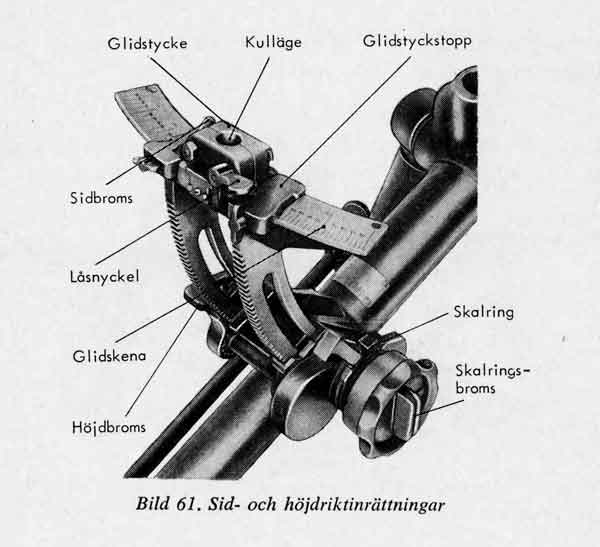 |
Picture of the
sector plate. From the Swedish
army manual. |
|
The
tripod could be released to allow the mount to lie directly on the ground
with the centre line of the bore being just less than 0,3 m above the
ground. This tripod was also called m/1914 in Sweden.
It was
a very simple and sound construction, so it became the platform for later
Swedish Medium Machine Guns like m/14-29 and m/36.
|
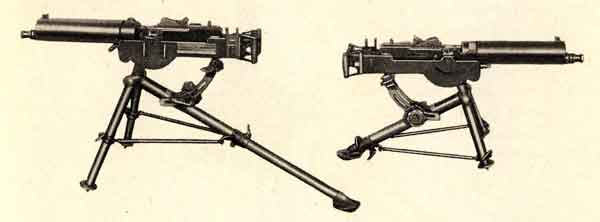 |
The Swedish MMG
Kulspruta m/36 on the tripod from m/14.
Swedish army
instruction manual from 1963 |
|
Specifications: |
|
Calibre: |
6.5 mm
Swedish m/94 |
|
Length: |
1020 mm |
|
Barrel
length: |
600 mm |
|
Weight: |
24,0 kg |
|
Cyclic
rate: |
480/minute |
|
Ammunition belts: |
250-round
fabric belt |
|
Mount:
|
Tripod m/1914 |
|
Mount
weight: |
20 kg |
More picture of Kulspruta
m/1914>>>
[Top of the
page]
|
Kulspruta m/14-29 |
|
Kulspruta m/14-29 is NOT a
Schwarzlose Machine Gun!
The Ksp m/14-29
is a
water cooled
Browning M1917 equipped in Sweden with
a
water cooling jacket from the Schwarzlose
MMG
Ksp
m/14.
The MMG
Ksp m/14-29 has also inherited the tripod.
The calibre was 6.5 mm.
It was used by the heavy Infantry Support
Platoons contrary to the light Infantry Platoons. These Support Platoons
were equipped with heavier weapons like this MMG Ksp m/14-29 and with 8 cm
trench mortars.
The Ksp m/14-29 was replaced by the
Browning Ksp m/36, which you can read more about
here>>>
|
 |
|
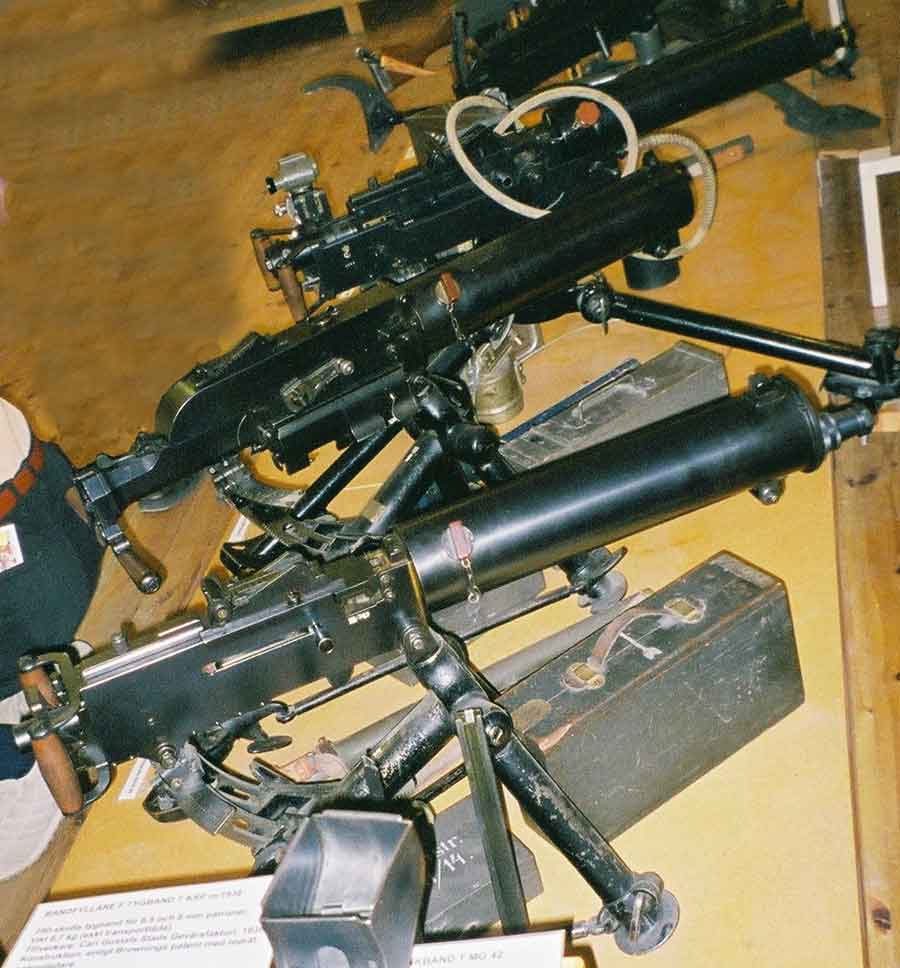
Closest
to camera you can see MMG Ksp
m/14-29;
in the middle Ksp m/1914;
and at the rear Ksp m/36 |
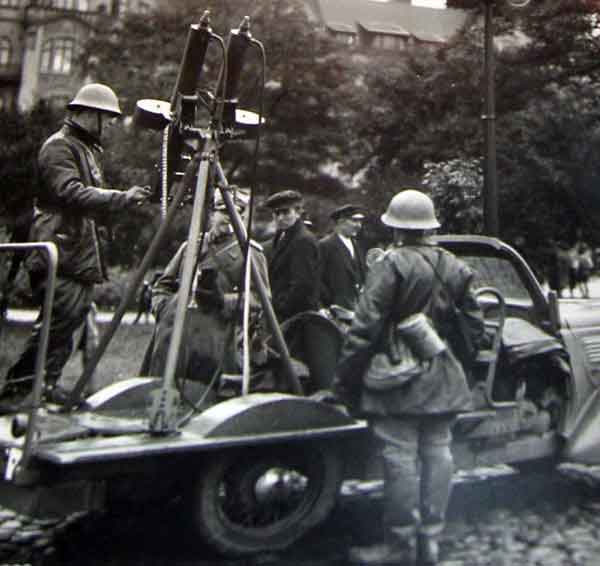 |
Picture from 1935
MMG Ksp
m/14-29 on a small lorry for air
defence. |
[Top of the
page]
|
References:
Smith &
Smith: Small arms of the world, Harrisburg, Pennsylvania
Ian Hogg Military small arms of the 20th century.
Alm: Eldhandvapen II
Stockholm 1934
Vapenmuseet, Eskilstuna.
Swedish army manual - Ammunitionsregister 1960 and 1964 F1092-065000
Swedish army manual - KULSPRUTA m/36 lv dbl, 1966
Swedish army manual - KULSPRUTA m/36 mark, 1963
|
|